
Category

News

Welsh Government Consultation response form

Building Regulations Part L 2025 Review Changes to Part L (conservation of fuel and power), Part O (overheating) and Part F (ventilation) of the Building Regulations for dwellings and non-domestic buildings

Date of issue: 26 August 2025
Action required: Responses by 17 November 2025

About the National Insulation Association

The National Insulation Association (NIA) represents the insulation industry in Scotland and across the UK with a member base comprised of installers, system certificate holders, and manufacturers who provide a wide range of insulation solutions for homes and buildings. The NIA and its members are fully committed to maintaining and raising standards within the insulation industry.

What level of uplift to the energy efficiency standards (i.e. improvements to the targets for performance metrics (see paragraph 2.42 for proposed metrics) in the Building Regulations should be introduced for the Part L 2025 standard?

Option 2

The NIA supports Option 2 as it promotes a higher level of airtightness and fabric performance. Its proposed airtightness rate is 1.5 (m³/(h·m²) at 50 Pa, which is stronger than the Part L 2022 standard and the proposed Option 1 standard. This means that less air will leak through the envelope area per hour, thereby preventing excess heat loss and minimising the energy needed for heating new homes. Although Option 2 has a higher capital cost, it will deliver energy bill savings for Welsh households and a greater reduction in carbon emissions. In this way, it will help the Welsh Government to meet both its fuel poverty and net zero targets.

Should the notional dwelling heat loss calculation be based on a single weather location (Cardiff)?

No, the NIA believes that the notional dwelling heat loss calculation should be based on localised weather data.

This is important because local weather determines the type and level of fabric measures that are appropriate for each property. Given the diverse geography of Wales, the use of granular weather data is important to ensure that properties are built in an appropriate manner. For example, Wales has a relatively high number of properties on hillsides or in coastal areas that may be regularly exposed to driving rain. Properties in these circumstances may need additional or tailored measures installed to prevent excess heat loss and water ingress. Using localised weather data is important to ensure that these local nuances and their implications are factored in during construction.

Do you agree with the revised guidance in Approved Document L, Volume 1: Dwellings for consultation no longer including the average compliance approach for terraced houses?

Yes

The NIA agrees with the proposal to remove the average compliance approach for terraced homes as we believe that properties should be required to demonstrate individual compliance with the Part L 2025 Standard. It is unlikely that all terraced houses on the same street will have exactly the same construction features, therefore they should be modelled separately and required to demonstrate compliance on an individualised basis.

Do you agree with the proposed approach to determine U-values of windows and doors in new dwellings?

The NIA agrees with the proposal to determine U-values of windows and doors in new dwellings via the Home Energy Model using the actual sizes and configurations. A window’s size, construction and level of glazing can have a significant impact on heat loss and overheating via solar gain. Therefore, the use of real data rather than standardised assumptions for window and door size and configuration is welcome.

Do you agree with the replacement of the Dwelling Energy Efficiency Rate with the Energy Use Intensity?

Yes

Yes, the NIA supports the replacement of the Dwelling Energy Efficiency Rate with the Energy Use Intensity (EUI). The EUI has a stronger focus on energy demand reduction, as such it will incentivise fabric improvements that lead to lower energy bills for Welsh residents. For example, an uninsulated home loses approximately 25% of heat through the roof and 33% through the walls, meaning more energy must be consumed and more CO2 emitted to maintain a comfortable level of warmth for residents.1 The EUI metric will promote energy efficiency upgrades that improve energy efficiency and lower bills for households.

1 Energy Saving Trust. Home insulation to reduce home heat loss. Available here.

Do you agree that the Home Energy Model should be adopted as the approved calculation methodology to demonstrate compliance of new dwellings with the Part L 2025 Standard in Wales?

Yes

The NIA agrees that HEM should be adopted as the calculation methodology to demonstrate the compliance of new dwellings with the Part L 2025 Standard. HEM is a more complex model that uses more granular input data than SAP, therefore it should be able to model more closely the real-world performance of a dwelling. Thus, we would like to see it implemented as the approved calculation methodology as soon as it is ready for regulatory use.

Do you agree that SAP should continue to be used to demonstrate compliance with Part L 2025 as an interim measure if the final version of HEM is not completed by the proposed coming into force date?

Yes

Yes, the NIA agrees that SAP should be used in the meantime, while HEM is being finalised. However, we urge the Welsh Government to adopt the Home Energy Model as soon as it is available.

Do you agree with the proposed changes to minimum building services efficiencies and controls set out in Section 6 of draft Approved Document L, Volume 1: Dwellings?

Yes.

Do you agree with the proposed changes to Section 4 of draft Approved Document L, Volume 1: Dwellings, designed to limit heat loss from low carbon heating systems?

Yes.

Yes, installing an adequate level of insulation for pipework and hot water storage vessels is vital to reduce excess heat losses and maximise the system efficiency of heating systems.

Do you agree with the proposed changes to Approved Document F, Volume 1: Dwellings to improve the installation and commissioning of ventilation systems?

Yes.

Yes, we agree with the proposed changes. The correct installation and commissioning of ventilation systems is critical to ensure that other building elements, such as insulation, operate effectively. If not installed and commissioned correctly, there is a risk of unintended consequences, including poor indoor air quality and damp and mould, which can pose health risks to residents. For this reason, we support the introduction of more guidance to support best practice for the installation of ventilation systems. Having said this, it is crucial that installers are not saddled with prohibitively costly testing requirements, therefore the Welsh Government should help to support smaller installers with the cost of any additional equipment needed to comply, through measures such as grants or loans for the purchase of relevant equipment.

Do you agree with proposed changes to Approved Document L, Volume 1: Dwellings and Approved Document F, Volume 1: Dwellings to (a) clarify the options for certifying fixed building services installations and (b) set out available enforcement options where work does not meet the required standard?

Yes.

Yes, more detail on certification and enforcement options is welcome to help installers carry out high quality work and remain compliant.

Do you agree with the proposed changes to minimum building services efficiencies and controls set out in Section 6 of draft Approved Document L, Volume 1: Dwellings?

Yes.

Do you agree with the proposed changes to Section 4 of draft Approved Document L, Volume 1: Dwellings, designed to limit heat loss from low carbon heating systems?

Yes.

Yes, installing an adequate level of insulation for pipework and hot water storage vessels is vital to reduce excess heat losses and maximise the system efficiency of heating systems.

Do you agree with the proposed changes to Approved Document F, Volume 1: Dwellings to improve the installation and commissioning of ventilation systems?

Yes.

Yes, we agree with the proposed changes. The correct installation and commissioning of ventilation systems is critical to ensure that other building elements, such as insulation, operate effectively. If not installed and commissioned correctly, there is a risk of unintended consequences, including poor indoor air quality and damp and mould, which can pose health risks to residents. For this reason, we support the introduction of more guidance to support best practice for the installation of ventilation systems. Having said this, it is crucial that installers are not saddled with prohibitively costly testing requirements, therefore the Welsh Government should help to support smaller installers with the cost of any additional equipment needed to comply, through measures such as grants or loans for the purchase of relevant equipment.

Do you agree with proposed changes to Approved Document L, Volume 1: Dwellings and Approved Document F, Volume 1: Dwellings to (a) clarify the options for certifying fixed building services installations and (b) set out available enforcement options where work does not meet the required standard?

Yes.

Yes, more detail on certification and enforcement options is welcome to help installers carry out high quality work and remain compliant.

Do you agree with the methods proposed for the simple and flexible approaches?

No.

No, we believe that fabric performance improvements should be considered under the simplified approach. It is important that an extension and the rest of the dwelling is insulated to a high standard. Including fabric improvements within the simplified approach would introduce another trigger point where a higher level of insulation can be installed within a property.

Do you agree with the proposed exemptions?

No.

No, we disagree that properties should be exempt if solar PV is not viable. In this scenario, there are a range of other technologies that could reduce the property’s energy demand and carbon. For example, a property’s roof may not be able to support solar PV but there could be no technical barriers to upgrading the insulation of heating system. Thus, other upgrades such as insulation, should be considered before giving a property an exemption.

Do you agree with the proposal to extend Part O of the Building Regulations to capture works on existing dwellings?

Yes.


Do you agree with the proposal to introduce additional commentary in Approved Document O: overheating on new extensions to existing dwellings where there is a relatively high percentage of glazing in the extension?

Yes.


Do you agree with the proposal to introduce new guidance in Approved Document O: overheating on replacement of window(s) in highly glazed flats?

Yes.


Do you agree with the proposal to introduce new guidance in Approved Document O: overheating on loft conversions to habitable rooms with new window(s) / rooflight(s) / dormer window(s)?

Yes.


What level of uplift to the energy efficiency standards in the Building Regulations should be introduced in 2025?

Other.

The NIA would like to see a combination of the two options implemented. While we agree with the strong fabric requirements under Option 1, we believe that these should be combined with a high use of on-site solar PV, covering a minimum 75% of the roof area (unless proven unfeasible). Combining these two aspects would deliver the highest reduction in energy bills and carbon emissions.


Do you agree with the proposed changes to minimum building services efficiencies and controls set out in Section 6 of draft Approved Document L, Volume 2: Buildings other than dwellings?

Yes.


Do you agree with the proposed guidance on the insulation standard for building heat distribution systems in Approved Document L, Volume 2: Buildings other than dwellings?

Yes.

Yes, installing an adequate level of insulation for pipework and hot water storage vessels is vital to reduce excess heat losses and maximise the system efficiency of heating systems.

Do you agree that the current guidance for buildings with low energy demand which are not exempt from the Building Regulations, as described in Approved Document L, Volume 2: Buildings other than dwellings should be retained without amendment?

Yes.

Do you have any further comments on any other changes to the proposed guidance in draft Approved Document L, Volume 2: Buildings other than dwellings?

No.

Do you agree with the introduction of photographic evidence as a requirement for producing the as-built energy assessment for new non-domestic buildings?

Yes.

The NIA agrees with the introduction of photographic evidence as a requirement for producing the as-built energy assessment for new non-domestic buildings. The NIA fully supports the amendments, noting that the regulation’s stipulation for evidencing insulation quality is a critical progression towards enhancing consumer protection and tightening oversight on installers across the non-domestic sector. This will offer greater assurances that fabric measures installed into new buildings have been safely, securely and sufficiently fitted to a high quality.

Do you agree with the proposed changes to minimum building services efficiencies and controls set out in Section 6 of draft Approved Document L, Volume 2: Buildings other than dwellings?

Yes.

Do you agree that the current guidance for buildings with low energy demand which are not exempt from the Building Regulations, as described in Approved Document L, Volume 2: Buildings other than dwellings should be retained without amendment?

Yes.

Do you have any comments on the changes to the proposed guidance in draft Approved Document L, Volume 2: Buildings other than dwellings?

No.

Do you agree that the 2010 and 2014 energy efficiency transitional arrangements should be closed down, meaning all new buildings that do not meet the requirements of the 2025 transitional arrangements would need to be built to the Part L 2025 standard?

Yes.

Do you agree that Part L1 of Schedule 1 should be amended, as above, to require that reasonable provision be made for the conservation of energy and reducing carbon emissions?

Yes.

Yes, we support these amendments.

Do you agree that regulations 25A and 25B will be redundant following the introduction of the Part L 2025 Standard and can be repealed?

Yes.

Which option describing the timescale between laying the regulations and them coming into force for the Part L 2025 Standard do you prefer?

Option 1 (6 months).

We believe that Option 1 should be implemented. This allows for a 6 month period between the regulations being laid and then coming into force. This aligns with the period provided for the 2022 Part L uplift, which included increases in minimum insulation standards. A 6 month period, combined with a 12 month transition period, should also be sufficient in this case. This will ensure that higher building standards are introduced as soon as possible.

Consultation on extending the ECO4 end date – National Insulation Association response

Consultation on extending the ECO4 end date – National Insulation Association response

Closing Date: 25th September 2025
Response submitted by: National Insulation Association
For more information, please contact: info@nia-uk.org

About the National Insulation Association

The National Insulation Association (NIA) represents the insulation industry in Scotland and across the UK with a member base comprised of installers, system certificate holders, and manufacturers who provide a wide range of insulation solutions for homes and buildings. The NIA and its members are fully committed to maintaining and raising standards within the insulation industry.

Do you agree that we should extend the date by which obligated suppliers may deliver to their ECO4 target, which is currently 31 March 2026, and other relevant dates, by 6 to 9 months?

No.

The National Insulation Association (NIA) does not support an extension in its current form. Extending the scheme by 6–9 months without increasing the overall obligation will slow delivery, reduce work flowing through the supply chain, and risk job losses in the insulation industry. This will destabilise businesses that have invested heavily in training, accreditation, and quality systems to meet demand.

During such an extension period, obligated suppliers will continue to collect revenues from consumer bills, potentially up to £1 billion across the sector (based on the current price cap), but without any corresponding obligation to increase the volume of installations. This creates a situation in which households are paying more, while the insulation industry is forced into a damaging lull in delivery.

If Government decides to extend ECO4, it must include a pro-rata increase in the obligation level so that suppliers are required to deliver more measures over the extension period. This would protect skilled jobs, maintain quality assurance, and prevent the boom-and-bust cycles that have previously undermined confidence in the sector.

For these reasons, the NIA believe that any extension must come with a proportionate uplift in targets.

Do you agree that the date by which obligated suppliers may deliver to their GBIS target, which is currently 31 March 2026, and other relevant GBIS dates, should remain unchanged?

Yes.

The NIA agrees the GBIS deadline should remain 31 March 2026. GBIS has been an ineffective scheme, therefore we do not think it should be extended. Government money is better spent on more effective insulation schemes that deliver better outcomes for residents.

Do you agree that energy suppliers should be able to carry-over up to 20% of their ECO4 obligation for use in a future obligation?

Yes.

However, as outlined our response to Question 1, there must also be a pro-rata increase in the obligation for suppliers, as well as an optional carry-over allowance. Previous ECO transitions have shown that carry-over often leads to a slowdown in delivery, which is particularly concerning at a time when both installation volumes and workforce stability are critical. This concern is supported by a survey conducted by the Insulation Assurance Authority Federation (IAAF), the trade body for the insulation sector. In a recent survey, the IAAF, which found that 91% of employers said that, without timely confirmation of an ECO4 extension, they would face difficult choices, including potential staff redundancies1.

With no additional mandatory obligation on suppliers and no detail about a future obligation scheme, it is very unlikely that suppliers will exceed their existing obligations and carry this over to a future scheme. The only way to continuity of funding and avoid a damaging hiatus between ECO4 and its successor is therefore to increase the obligation level on suppliers. They will not spend extra money on additional delivery unless they are obligated to do so.

To mitigate the risk of a serious slowdown in delivery, we believe Government must provide early, binding assurances:

  1. That a successor obligation will be established, with costs recoverable through the price cap.
  2. That clarity will be provided on eligible measures and scoring so suppliers can be confident that work delivered under ECO4 will count towards their future targets.

It is also essential that Government launches a consultation on the Warm Homes Obligation within the Warm Homes Plan and provides prompt responses to this ECO4 consultation alongside impact assessments. Certainty is vital to give suppliers the confidence to continue investing. Without it, there is a real risk that delivery will stall as businesses adopt a wait and see approach.

1 Installation Assurance Authority Federation. 2025. Member survey: Summary of responses. Available here.

Do you agree that the solid wall minimum requirement and EFG minimum requirement should remain at their current levels and should be achieved by the new end date of ECO4?

No.

As with the overall obligation itself, the solid wall and EFG minimum requirements must be increased on a pro-rata basis in line with the length of the extension period. 90% of solid wall homes in the UK are still uninsulated2 and 15% of homes remain at EPC E or below3.

Therefore, it is urgent that delivery of measures to these homes does not slow down. This risks leaving residents living in some of the UK’s poorest performing homes behind. The minimum requirements play a vital role in reducing bills for households in the least efficient homes, tackling damp and cold, and ensuring a steady pipeline of investment into the insulation and retrofit sector.

It is important, however, to recognise ongoing concerns around the quality of some solid wall installations. In our view, the central issue lies not only with contractors but also with certification bodies responsible for oversight, some of which hold financial interests in both installing and auditing work. Greater scrutiny and accountability of these bodies is essential.

There is a clear need to distinguish between:

  • Contractors or subcontractors who have delivered poor-quality work, and
  • Those with a proven track record of installing to a consistently high standard.

The latter group should be supported to continue delivering against scheme requirements, rather than penalised because of the failings of other contractors. As outlined in our response to Question 7, the solution to quality issues is a radical overhaul of the consumer protection landscape on ECO4. Solid wall insulation has been installed in UK homes for decades is proven to have hugely beneficial impacts for residents, when done correctly.

Maintaining the current minimum requirements provides an important signal that quality standards must be upheld, while also protecting consumer confidence and sustaining a skilled workforce. To strengthen this further, Government should prioritise the use of real performance measurement tools. Outcome-based monitoring, such as pre- and post-retrofit performance data, would address gaps in the current audit regime, which we believe is insufficient. ECO has historically focused on delivery volumes and credits, rather than outcomes, and this has contributed to quality issues. We therefore urge Government to build on ECO4’s previous commitment to integrate SMETER technology and adopt a stronger outcome-based framework through the forthcoming Warm Homes Plan and Warm Homes Obligation.

Finally, while we recognise that inquiries into solid wall measures are ongoing, we believe it would be a mistake to let the actions of a small number of rogue operators undermine confidence in fabric-first approaches. Insulation remains fundamental to decarbonisation—there is little value in installing low-carbon heating into homes that leak three times more heat than an insulated property4.

2 Department for Energy Security and Net Zero. 2025. Household Energy Efficiency Statistical Release 27 March 2025. Available here.

3 Department for Levelling Up, Housing and Communities.2025. Energy Performance of Buildings Data England and Wales. Available here.

4 Energy Transitions Commission. Achieving Zero-Carbon Buildings: Electric, Efficient and Flexible. February 2025. Find here

Do you agree that the two conversion methodologies represent the best solutions to facilitate delivery in the transition to a future obligation? If not, please provide alternative proposals.

No.

Carry-over can only be effective if suppliers have a clear understanding of what every £1 spent on ECO4 measures will be worth under the new scheme. Energy suppliers are commercial organisations: they will not commit funds without visibility of the likely return. Without this certainty, investment will stall during the transition.

Of the two conversion methods proposed, we do not believe they are equally viable:

  • Global ABS conversion factor (confirmed in the Final Stage Impact Assessment): This approach is unworkable. The Final Impact Assessment is unlikely to be published until just before the launch of any successor scheme. If, for example, a new scheme were to begin in January 2027 but the Final Impact Assessment were not available until October 2026, this would leave little or no time for suppliers to use carry-over effectively. By then, most of the critical transition period (Jan–Dec 2026) would already have passed, meaning clarity would come too late to avoid disruption.
  • Initial Estimate of £1 ECO4 ABS value in a future scheme: This approach could work if applied correctly. For it to succeed, two conditions must be met: The initial estimate must be set at a commercially realistic level. The ECO4 impact assessment rate was ~£17.80. If the carry-over estimate were around £18, utilities could continue contracting at a viable rate (for example, ~£17), with confidence that the value would be recognised under the new obligation. However, if the estimate were set artificially low (e.g., below £14), the economics would not stack up, and carry-over would not take place.
  • The estimate must be published early—by January 2026 at the latest—so suppliers can issue contracts in good time. If clarity is delayed until March 2026 or later, it will be of little practical value, as the industry will already be winding down.

It is also important to recognise that even if the new scheme launches in 2027, suppliers need significant lead-in time to set up systems, audit processes, and prepare supply chains. Policymakers often underestimate how much groundwork is required before a scheme can go live.

On this basis, while we think suppliers should be able to select their conversion factor, the key issue is that they must be given early and realistic certainty. Without it, suppliers will simply withhold investment, and delivery will fall away.

Are there any measure types that you believe should not be eligible for carry-over?

No.

We do not believe any measure types should be excluded from carry-over. Provided strengthened auditing and consumer protection processes are in place—as the Government has proposed—all measures should remain eligible. This will help avoid unnecessary gaps in delivery and maintain confidence in the scheme.

Are there any additional consumer protection reforms we should introduce during the EC04 deadline?

Yes.

We believe that the certification bodies responsible for overseeing ECO delivery must themselves be subject to greater scrutiny. There have been significant failures in consumer safeguarding, and these shortcomings must be addressed, including a review of potential conflicts of interest where organisations are both installing and auditing measures. The forthcoming National Audit Office (NAO) report on the ECO scheme will be important in this respect, and its findings should be carefully considered to inform stronger consumer protections during the ECO4 extension.

While it is important to acknowledge that poor-quality work has been carried out by a minority of contractors, many installers have consistently delivered high-quality solid wall insulation in line with certification standards. These legitimate installers should be supported to continue their work, rather than penalised by broad-brush approaches.

Consumer protection should include real performance measurement. Current auditing processes are insufficient, with certification bodies often failing to provide effective oversight. A shift to outcome-based approaches, monitoring pre- and post-retrofit performance, would help to drive up standards and rebuild consumer confidence.

We therefore recommend that the Government prioritise the integration of SMETER technology and set this out clearly within the forthcoming Warm Homes Plan and Warm Homes Obligation. This would provide a vital step toward embedding outcome-based protections across retrofit schemes.

Do you agree with our proposal not to allow any new applications for innovation measures or data light measures over the extension period?

Yes.

We agree with the proposal. Given the limited length of the ECO4 extension, it makes little sense to commit time and resources to new applications under a scheme that will shortly be replaced. Efforts should instead be focused on ensuring that the successor scheme is established and operational without delay. Concentrating on a clear and well-functioning replacement framework will provide greater certainty for industry and avoid unnecessary duplication of work.

Consultation on Draft Energy Efficiency (Domestic Private Rented Property) (Scotland) Regulations – National Insulation Association response

Consultation on Draft Energy Efficiency (Domestic Private Rented Property) (Scotland) Regulations – National Insulation Association response

Closing Date: 29 August 2025
Response submitted by: National Insulation Association
For more information, please contact: info@nia-uk.org

About the National Insulation Association

The National Insulation Association (NIA) represents the insulation industry in Scotland and across the UK with a member base comprised of installers, system certificate holders, and manufacturers who provide a wide range of insulation solutions for homes and buildings. The NIA and its members are fully committed to maintaining and raising standards within the insulation industry.

Do you agree that the PRS MEES should be Energy Performance Certificate (EPC) Heat Retention Rating (HRR) band C?

The NIA supports the proposal to have PRS MEES require improvements for private rented homes to reach EPC Band C. The 2023 Scottish House Condition Survey found that 48% of all PRS homes were within EPC band D or lower.1 It is of vital importance that homes reach band C or higher as this category is associated with several environmental and financial benefits for residents.

Renters living in homes with an EPC D-G are 73% more likely to experience damp and 89% more likely to experience excessive cold than those in homes EPC A-C.2 Furthermore, homes with an EPC D-G could save between £555 and £7,188 annually on energy costs by upgrading to an EPC C (depending on their current EPC band and property type).3 Making all private accommodation conform to EPC C requirements will not only improve thermal comfort and fabric performance but also deliver lower bills for the 44% of Scottish PRS households in fuel poverty and prevent exposure to damp and mould.4Aligning the standard for both private and social rental sector homes to EPC C is an appropriate measure.

1 The Scottish Government (2025) The Scottish House Condition Survey: 2023 Key Findings. Available here.
2 Citizens Advice (2023). Damp, cold and full of mould. Available here.
3 Rightmove (2025) What’s the average UK energy bill? Available here.
4 The Scottish Government (2025) The Scottish House Condition Survey: 2023 Key Findings. Available here.

Do you agree that only new reformed EPCs should be used as a basis for the proposed MEES?

The NIA agrees that new reformed EPCs should be used where possible for compliance with the new MEES. However, we believe that a property compliant with EPC Band C under current regulations should be recognised as compliant under the new standard. This will allow upgrades for the least energy-efficient PRS properties in EPC bands D-6 to be prioritised.

Furthermore, landlords would benefit from a defined transition period – possibly until the current EPC for their property expires – to make upgrades without risking non-compliance. Both measures will ensure clarity as the sector prepares for the new standard.

Do you agree that the backstop date for all PRS homes to comply with MEES should be 2033?

The NIA supports the proposed backstop date of 2033 for PRS compliance with the MEES. Whilst the MEES should be implemented as soon as possible to support home decarbonisation and tenant wellbeing, we recognise that supply chain constraints and upgrade costs for landlords necessitate a transition period. This will give landlords the appropriate amount of time to understand details of the new standard and make the upgrades to achieve a compliant EPC.

Do you agree that the MEES should apply to properties being let to new tenants from 2028?

The NIA supports the proposed timeline, but changes to the EPC metrics must be implemented sooner to support upgrades in PRS properties. The consultation indicates that new EPC metrics will not go live until Autumn 2026, leaving less than two years for landlords to achieve MEES compliance for their properties by 2028. Implementation of the EPC reform by the end of 2025 will enable landlords to prepare for upgrade costs or submit exemptions where necessary.

Nevertheless, we support the principle of a deadline for landlords taking on new tenants to achieve MEES compliance. This will encourage first-time landlords to achieve compliance before tenancies begin, thus protecting tenant wellbeing from the offset and avoiding the disruption of making upgrades whilst tenants are living in the property. This will also encourage current landlords to use the time where there are no tenants living in the property to make appropriate upgrades, ensuring that landlords do not delay taking action until nearer the 2033 backstop date.

Do you agree that, regardless of changes to the repairing standard, that crofters, small landholders and agricultural holdings should be excluded from PRS MEES?

No comment.

Do you agree that the regulations should exclude short-term holiday lets from the PRS MEES?

No comment.

Do you agree with the proposed exemptions covering consent, the fabric requirements of the home and temporary exemptions?

No comment.

Do you agree that Heat & Energy Efficiency Technical Suitability Assessment (HEETSA) should be available as an option to evidence potential negative impacts on the fabric of a property and to support an exemption?

Yes, the NIA agrees that a Heat and Energy Efficiency Technical Suitability Assessment (HEETSA) should be available as an option to evidence potential negative impacts on the fabric of a property and to support an exemption.

In our response to the Scottish Government’s HEETSA consultation, we highlighted the importance of including a thorough risk assessment within the HEETSA methodology. This should include a detailed technical suitability assessment to evaluate whether retrofit interventions are technically suitable for an individual property. It should also consider

potential barriers and risks to retrofit measures, such as the age and condition of the building, space constraints, and the protected status of the building (if applicable). Given that a HEETSA would evaluate these potential risks in much more detail than is currently done within an EPC assessment, we agree that it should be used to determine whether potential measures could have a negative impact on the structure or fabric of a building. If a HEETSA or other relevant assessment by a qualified professional deems that there is a high risk of such an issue occurring, then this could be used to support an exemption to MEES standards.

Do you agree that the cost cap level should be £10,000?

The NIA supports the implementation of a cost cap of £15,000. We believe that a higher cost cap level will ensure landlords can afford to make the appropriate upgrades. For landlords who own the 14% of PRS properties in current EPC bands E-G, this higher cost cap level would increase the likelihood of their properties reaching EPC Band C compliance.

Furthermore, lower EPC ratings correspond strongly to worse social outcomes, with 48% of households in properties within EPC Bands F or G being fuel-poor compared to 32% in properties rated EPC Band C or better.5 A higher ceiling on the maximum investments a landlord can make will support the most vulnerable tenants in the least energy-efficient properties.

5 The Scottish Government (2025) The Scottish House Condition Survey: 2023 Key Findings. Available here.

Do you agree with the proposed 12-month lead in time period for works to contribute to the total cost cap?

The NIA supports a longer, more realistic lead-in period of two years to enable landlords to be MEES-compliant. A lead-in time period for works to contribute to the total cost cap is an appropriate measure, as it would encourage landlords to invest in property upgrades quickly and ensure their tenants can receive the benefits of energy efficiency as soon as possible. However, the availability of skilled labour may pose a challenge to this timeline. The shortage of capacity in the energy efficiency supply chain will make the transition in the PRS sector much more difficult to achieve. As such, landlords should be given a more appropriate lead-in period of two years so they can achieve compliance amidst a challenging skills climate.

Do you agree that all actual costs, and the cost of an EPC, should count towards the cost cap?

The NIA believes that as much of the cost cap as possible should be reserved for the actual costs of efficiency upgrades made by landlords to achieve MEES compliance. Given that an EPC is necessary for landlords to know whether their property is compliant or not, it would be reasonable to include the EPC in the final cost cap. However, to minimise the opportunity for gaming, a maximum reflecting the upper range of average EPC assessment costs (e.g. £150) should be set for how much can be spent on an EPC assessment. Nevertheless, the need to include an EPC assessment in the cost cap would be reduced if landlords were required to comply with the new standard only when their existing EPC expires and not prior to that.

Do you agree that landlords should receive Scottish Government support to make the required changes?

The NIA supports landlord access to a broad range of low-cost green finance options to reduce financial risk and incentivise investment. This will support the delivery of MEES and enable the benefits to be captured for tenants and for the benefit of improving the housing stock for the future.

The NIA believes that affordability for landlords can be addressed by providing access to a range of low-cost green finance options, alongside appropriate grant support such as through Warmer Homes Scotland. This would mitigate the cost impact on landlords whilst ensuring fair outcomes for tenants. Without broad access to a range of green finance solutions there is a risk that landlords less able to afford the cost of a £15,000 investment sell on their properties to the private sector (owner occupiers). Other unintended consequences could be increased rents in certain areas due to reduced supply of properties on the rental market.

Under the right conditions, with access to a broad range of support, the decarbonisation of private rented housing stock is feasible given the greater abundance of private capital. It will be important to develop and market this to support the delivery of MEES and ensure landlords are aware of what support is available to them.

Do you agree that this should be in the form of a loan?

The NIA agrees with the proposal for support to be provided in the form of a loan to landlords particularly as there is an existing scheme providing similar retrofit focused support; the Private Rented Sector (PRS) Landlord Loan Scheme. This scheme offers considerable financial support with close to £40,000 available for single properties and up to £100,000 for up to 5 properties through an interest free loan. Access to support will encourage investment and deliver the desired outcomes of MEES.

Support can also be provided through other green finance solutions to help mitigate risk to landlords including:

– Green Mortgages
– Tax incentives and green allowances
– Green bonds and investment funds which could have the dual benefit of supporting local area delivery schemes benefiting multiple homes at once.
– Property-Linked finance, which ensures repayment even if the landlord sells their property.
– Energy Performance Contracting / ESCO Models, helping to reduce upfront costs for landlords.

Do you agree that Local Authorities should be responsible for monitoring and compliance of these regulations?

The NIA believes that Local Authorities should play a role in monitoring and compliance however, they have faced challenges due to limited funding and resource capacity meaning.6 Local Authorities may in some cases lack resource and technical expertise to do this effectively. This echoes the situation in England and Wales for MEES delivery.7

The best model for enforcement in part depends both on the delivery of financial support from Government and how landlords choose to invest. For example, where landlords receive funding from funding schemes such as the Private Rented Sector (PRS) Landlord Loan Scheme or Warm Homes Scotland, monitoring and compliance can be supported by the administrative teams delivering these schemes.

In the case that Local Authorities are responsible for monitoring and compliance with these regulations, the Government should ensure they are effectively supported with the additional finances and staffing required to deliver these functions. The importance of having a sufficiently resourced supply chain to support monitoring and compliance cannot be understated. With record investment in retrofit there is a need to address supply chain weaknesses to ensure the desired outcomes are realised.

6 Scottish Government (2018) Energy Efficient Scotland: consultation analysis. Available here.
7 Inside Housing (2024). Councils lack capacity to enforce compliance with minimum energy-efficiency standards, warns expert. Available here.

Do you agree with the proposed level of financial penalties to support compliance with the regulations?

The NIA believes that the fine level should be, at a minimum, higher than the proposed cost cap of £10,000 to ensure landlords are not incentivised to be non-compliant. If the fines are lower than the cost cap, then landlords may feel it is less costly not to invest in their property.

Given that the aim of this policy is to raise the energy efficiency of private rented housing, the Government and Local Authorities (LAs) should focus on supporting landlords towards compliance and reserve fines for cases where landlords deliberately refuse to engage.

As highlighted previously in the response, LAs have faced longstanding issues of inadequate resourcing and technical expertise in the retrofit space. If they are to take on the responsibility of engaging with landlords to drive compliance, they must be given the necessary resources to do so effectively.

Do you agree that the Scottish Government should seek to amend the Energy Act 2011 to increase in maximum financial penalties that could be imposed up to £30,000 in future, should this be deemed necessary?

The NIA agrees that should there be a need to increase the maximum penalty, for example if non-compliance is taking place without recognised exemptions being registered, then an increase in the penalty should be considered. This must again be balanced with adequate financial support for landlords and sufficient resourcing to support monitoring and compliance efforts for LAs.

In what way could these regulations have a specific or different impact, positive or negative, on a particular group of people? This could be based on protected characteristics, such as age or disability, or geography, such as island communities.

No comment.

Click here to download

Heat and Energy Efficiency Technical Suitability Assessment (HEETSA) Scoping Consultation – National Insulation Association response

Consultation Response – Heat and Energy Efficiency Technical Suitability Assessment (HEETSA) Scoping Consultation – National Insulation Association response

Closing Date: 29 August 2025
Response submitted by: National Insulation Association
For more information, please contact: info@nia-uk.org

About the National Insulation Association

The National Insulation Association (NIA) represents the insulation industry in Scotland and across the UK with a member base comprised of installers, system certificate holders, and manufacturers who provide a wide range of insulation solutions for homes and buildings. The NIA and its members are fully committed to maintaining and raising standards within the insulation industry.

To what extent to you agree or disagree that it would be valuable for the Scottish Government to develop a HEETSA (a government-led approval and accreditation mechanism to provide oversight and standardisation of the retrofit assessment market)?

Setting a standard for the retrofit assessment market that improves the quality of advice available to building owners will add confidence to building owners seeking advice. This should in turn encourage more building owners to invest in upgrades to their properties.

As the consultation notes, EPCs have a number of limitations which limit their usefulness as a tool for helping residents make informed decisions about the most suitable retrofit upgrades for their properties. EPCs are based on a simple, non-invasive assessment of a building that does not take into account occupancy or the unique features of a building. Moreover, the scoring methodology that underpins EPCs is based on assumptions about the impact of retrofit measures on a building rather than measured data showing the real impact of measures. As a result of these limitations, the findings and recommendations on EPCs are often inaccurate and generic. In response to a survey conducted by the National Retrofit Hub, 57% of respondents felt that they had little to no trust in the ratings and content of an EPC. The same research also found that contractors generally do not find EPCs useful for supporting their professional decision making, with 41% reporting they rarely or never use EPC recommendations for project planning or advising clients1.

Therefore, we welcome the Scottish Government’s proposals to develop a HEETSA which would provide a more detailed and building-specific assessment of a property than an EPC. This will give residents a more accurate picture of the true condition of their property and help

to inform them on the most suitable upgrades for their individual circumstances. By providing more reliable and property-specific information than EPC assessments, HEETSAs could also help to inform more targeted and effective policy interventions by the Scottish Government.

1 National Retrofit Hub (2024). What is needed from EPC reform to enable retrofit at scale? Available here.

If the Scottish Government develops a HEETSA, which of the following should it cover (select all that apply):

• Retrofit assessment (i.e. identifying whether measures are present or can be installed)
• Retrofit design (identifying the types of measures (e.g. loft insulation) that can be installed)
• Retrofit specification (identifying the products or materials (e.g. mineral wool) that can be installed)
• Installation (identifying the relevant installation standards)
• Evaluation (planning an approach to evaluating the impact of measures)
• Occupancy (including factors related to the building’s current occupancy in assessment of suitable measures)
• Other – please specify

The NIA believes that a HEETSA should cover the following elements:

  • • Retrofit assessment
  • • Retrofit design
  • • Retrofit specification
  • • Occupancy

Retrofit assessment

The HEETSA should cover retrofit assessment, involving an extensive survey of a building and its current condition. As the consultation suggests, this should include an evaluation of the current state of the building fabric. We believe that a whole-house approach to retrofit assessment and retrofit projects is the most effective approach, therefore it is important that it also includes a ventilation assessment, alongside any assessment of the building fabric.

We agree that this should include a detailed technical suitability assessment of potential retrofit measures, conducted by an appropriately qualified professional, to determine which interventions are technically feasible. The HEETSA should also evaluate any potential risks or barriers to retrofit measures, such as space constraints, enabling works, and the protected status of the building (if applicable). These risks must be carefully considering when recommending the most suitable measures for each property.

Retrofit design

We believe that a HEETSA should incorporate certain elements from the retrofit design stage within PAS 2035:2023. This will help to ensure that HEETSAs provide a suitable package of recommendations tailored to the individual needs of the building being assessed.

This should include a full cost-benefit analysis of the estimated impacts of different retrofit measures, similar to the improvement options evaluation within PAS 2035 retrofit design. This should cover the whole-life carbon, through-life cost, and potential health implications of individual measures. Residents can then use this information to make an informed decision on the most appropriate retrofit strategy for their home.

A medium-term improvement plan should also be carried out. This should take into account any risks or barriers to retrofit interventions and identify the best package of measures for improving the energy performance of a particular property. In line with the importance of a whole-house approach to retrofit, this should identify the best order for measures to be installed in and highlight any potential issues arising from the interactions between measures.

Retrofit specification

A HEETSA should consider the specification of measures. This is important to ensure that the proposed package of measures works together effectively and does not pose a risk to the property. While it would be the decision of the property owner whether or not they wish to proceed with certain measures, it is important that they are provided with detailed information on the most suitable measures and approach to installing them as part of a whole-house retrofit package. This will reduce the risk that building owners choose to install measures or packages of measures that may have unintended consequences for their properties.

Occupancy

We welcome the Scottish Government’s proposals to include occupancy within the scope of a HEETSA. Occupancy factors are important to consider when assessing the energy performance of a building and the most appropriate improvement measures. A full occupancy assessment helps to provide a more reliable picture of how a building performs and is used in the real-world. It is also critical to consider occupancy when assessing moisture and mould risk, as these can often be exacerbated by occupant behaviour. Considering occupancy and how it impacts upon these factors is vital to ensure that HEETSAs achieve their aim of providing a building-specific and occupant-centric assessment. It is also important that a HEETSA’s recommendations are tailored to the individual needs of the building and its occupants.

Which delivery model do you think would be most appropriate for HEETSA?

• Direct Government accreditation of assessors
• Government accreditation of assessor organisations who in turn accredit assessors
• HEETSA as guidance only without Government accreditation of assessors
• Other – specify

The NIA believes that the Government should accredit assessor organisations who in turn accredit assessors.

What methodologies would be needed to meet the requirements of a HEETSA?

To ensure that the methodology used for a HEETSA is robust and fit for purpose, we believe that it should incorporate aspects from existing, government-approved methodologies. As the leading government- and industry-recognised framework for carrying out high-quality retrofit, HEETSA should build on existing elements of PAS 2035:2023. This includes detailed provisions for carrying out a thorough occupancy and retrofit assessment, as well as guidance on how to design and specify a suitable package of retrofit measures for an individual building.

However, we also recognise that a HEETSA may want to go beyond PAS in certain instances. In our view, HEETSA could incorporate elements of these other methodologies to help enhance the existing provisions within PAS 2035:

  • • Scottish Building Standards – Technical Handbook
  • • British Board of Agrement (BBA)
  • • Reduced Standard Assessment Procedure (RdSAP) and Standard Assessment Procedure (SAP)

In addition to these existing methodologies, the HEETSA methodology should incorporate data on the in-use performance of energy efficiency measures. The use of pre-project use data is already collected in Wales and should be required within HEETSAs too. Using monitored data rather than the generic assumptions used in EPCs will allow HEETSAs to achieve a much more accurate picture of a building’s in-use performance than is possible with an EPC. This will in turn help to support more targeted and effective recommendations and interventions.

When it comes to individual factors within a building, we believe that a HEETSA should consider the following:

  • • building fabric and performance, including insulation levels and thickness,
  • • airtightness,
  • • thermal bridging,
  • • glazing,
  • • ventilation,
  • • heat loss calculations prior to retrofit installations
  • • construction and condition of the building
  • • age and type of building (solid wall, cavity, timber frame),
  • • structural integrity,
  • • damp,
  • • heritage constraints,
  • • location and external factors,
  • • local climate (e.g., Scottish Highlands vs. southern England),
  • • grid capacity,
  • • space for external units,
  • • noise constraints,
  • • planning rules,
  • • occupant needs and usage patterns,
  • • vulnerable occupants (e.g., elderly, fuel-poor)

There are a range of ways that identified gaps could be filled – by the market, or by the Scottish Government procuring and developing methodologies to do this. What do you think is the best approach to filling identified gaps in the methodologies required for HEETSA? Please give reasons for your view.

The NIA believes that the Scottish Government should procuring and develop methodologies for HEETSAs. However, we also think that the market has a role to play in helping to fill gaps within existing methodologies.

What skills and qualifications should be required to undertake a HEETSA? Please name existing qualifications that would be relevant and highlight any gaps that you think should be filled by new skills or qualification requirements:

HEETSA assessors should draw on existing qualifications, such as Domestic Energy Assessment and PAS 2035 roles, but add additional elements and accreditations where more specialist skillsets are required.

Which of the following statements comes closest to your view:

• It is feasible for an individual assessor to have sufficient skills and knowledge to complete a HEETSA
• A HEETSA would require input from multiple specialists and could not be completed by an individual
• Don’t know
• Other – please specify Please provide reasons for your view.

We believe that it is feasible for an individual assessor to have the sufficient skills and knowledge to complete a HEETSA, however as mentioned in our response to Question 6, they may require some additional accreditation and training.

To what extent do you agree or disagree that non-personal data gathered through a HEETSA should be stored to form part of a ‘building logbook’ or ‘green building passport’?

• Strongly agree
• Mostly agree
• Neither agree nor disagree
• Mostly disagree
• Strongly disagree
• Don’t know
Please give reasons for your view.

The NIA strongly agrees that non-personal data gathered through a HEETSA should be stored to form a building logbook or green building passport. A 2024 report on EPC reform published by the National Retrofit highlighted the need for EPC data to be more accessible to the retrofit industry, landlords, homeowners and service providers2. Keeping track of this information through a building logbook will provide residents, industry and government with a wealth of data on the historic condition of buildings, as well as a guide for future improvements. This could be used to underpin a number of policy interventions. We agree that data gathered via a HEETSA should be stored in green building passports, as a reliable source of granular data on the condition of a building.

2 National Retrofit Hub (2024). What is needed from EPC reform to enable retrofit at scale? Available here.

To what extent do you agree or disagree that the HEETSA assessor should be required to be independent of the outcome of the assessment? E.g. they could not financially gain from the outcome if a measure is stated as technically suitable.

• Strongly agree
• Mostly agree
• Neither agree nor disagree
• Mostly disagree
• Strongly disagree
• Don’t know
Please give reasons for your view.

The NIA strongly agrees that the HEETSA assessor should be required to be independent of the outcome of the assessment.

Thinking about the relationship between the EPC and HEETSA, which of the following statements comes closest to your view:

• The results of a HEETSA should result in the production of a revised EPC as part of its output
• The results of a HEETSA should be made available to inform the production of a revised EPC and should be considered acceptable ‘documentary evidence’ to override default values.
• The results of a HEETSA should not have any influence on the EPC and its ratings
• Don’t know
• Other – please specify
Please provide reasons for your view.

The NIA believes that the results of a HEETSA should be made available to inform the production of a revised EPC and should be considered acceptable “documentary evidence” to override default values.

As noted in our response to Question 1, there are a number of issues with EPCs which limit their accuracy. In-depth research conducted by Leeds Beckett University between 2008 and 2016 showed that at least 27% of all EPCs lodged between 2008 and 2016 had a discrepancy that suggests an error was made (3). Therefore, if a more detailed and reliable HEETSA assessment has been carried out, we believe that this data should be able to override default EPC values, which are often inaccurate, We don’t think HEETSA findings should automatically result in the production of a revised EPC, as there may be instances where this is not suitable. However, we generally believe that an EPC should be based on the best data available at the time, which is likely to be a HEETSA if this has been carried out.

3 Hardy, ALR and Glew, D. 2019. An analysis of errors in the Energy Performance certificate database. Available here.

Thinking about presenting the results of a HEETSA, please give your view on: (a) Whether the HEETSA should result in a standardised certificate or report?

• Strongly agree
• Mostly agree
• Neither agree nor disagree
• Mostly disagree
• Strongly disagree
• Don’t know
(b) What information should be included when presenting the results? Please provide reasons for your view.

a) The NIA strongly agrees that a HEETSA should result in a standardised certificate or report. Standardisation is important so that property owners and occupants can easily compare the performance of their building against others. This will also make a HEETSA’s findings more accessible and easier to understand for residents, hence helping them to make more informed decisions about future upgrades to their properties.

b) We believe that the following information should be included within the HEETSA report or certificate:

  • Current state of the building fabric, including insulation and ventilation.
  • Recommended energy efficiency and ventilation measures, with suitable justifications.

Please provide details of any circumstances in which you think a HEETSA should be required, and the reasons for your view. Please provide reasons for your view.

We believe that HEETSAs should be optional for those building owners or occupants who wish to find out more detailed information about their building and possible energy performance improvements. However, we do not think HEETSAs should be a mandatory requirement.

Do you think it is necessary to develop a legal basis for HEETSA? (i.e. should HEETSA be underpinned by regulations in a similar manner to EPCs)

• Yes
• No
• Don’t know
Please give reasons for your view.

No, given that HEETSAs are currently intended as an optional further assessment, we do not think it is necessary to develop a legal basis for them at this time.

Click here to download

Consultation Response – Energy Company Obligation 4 & the Great British Insulation Scheme: Consultation on mid-scheme changes

Consultation Response – Energy Company Obligation 4 & the Great British Insulation Scheme: Consultation on mid-scheme changes

Consultation: Energy Company Obligation 4 and the Great British Insulation Scheme: consultation on mid-scheme changes

Closing Date: 12 December 2024

Response submitted by: National Insulation Association

For more information, please contact: info@nia-uk.org

About the National Insulation Association

The National Insulation Association (NIA) represents the insulation industry in the UK with a member base comprised of installers, system certificate holders, and manufacturers who provide a wide range of insulation solutions for homes and buildings. The NIA and its members are fully committed to maintaining and raising standards within the insulation industry.

Part 1: Mid-scheme changes to current requirements

Do you agree that a household should be able to receive both loft and cavity wall insulation under GBIS?

Yes, we agree that eligible households should be able to receive both loft and cavity wall insulation under GBIS. This change will improve outcomes for residents and installers. As noted in the consultation document, fixed costs for installers, including compliance costs, are very high proportionally when only carrying out a single low cost measure. This means that it is often not viable or profitable for installers to work on the scheme, the knock-on effect of this being a shortage of installers willing to work on GBIS because many will favour more profitable schemes like ECO4.

Under the current scheme rules, a home may be need of both a loft insulation top up and cavity wall insulation, however it would only be allowed one of these measures. From an insulation perspective, this is counterproductive because about one-third of all the heat lost in an uninsulated home escapes through the walls1. Hence, by topping up loft insulation but not carrying out cavity wall insulation at the same time, the heat loss problem will not be effectively solved because a significant amount of heat will still be lost through uninsulated cavity walls. For this reason, we support the proposed amendment to allow households to receive both loft and cavity wall insulation.

However, it is our view that this multi-measure approach should be extended to cover all eligible measures. A whole house, multi-measure approach to retrofit will always deliver the best outcomes for residents in terms of thermal comfort and energy bill savings. Moreover, while loft insulation and

cavity wall insulation are undoubtedly effective measures, there are many other insulation measures which can deliver significant energy savings for households. Even if loft and/or cavity wall insulation is installed in a home, the building may still be leaving significant amounts of heat through other building elements. For example, if a home has uninsulated solid walls, residents could be losing 45% of their heat through the walls. In addition, up to 15% of the heat in a room can be lost through uninsulated floors2, while air infiltration through a sash window in good condition can be reduced by as much as 86% by adding draughtproofing3. If these major sources of heat loss are left untreated, residents will remain cold and their energy bills remain unnecessarily high, even after receiving support through GBIS. Therefore, we believe that the potential for installing multiple insulation measures through GBIS should not be limited to loft and insulation but should instead be extended to any combination of insulation measures that are recommended on a valid retrofit assessment. This will support a holistic, whole house approach to retrofit which will deliver much better outcomes for residents than a piecemeal, single measure approach.

1 Energy Saving Trust (2024). Cavity wall insulation. Available at: How to install cavity wall insulation – Energy Saving Trust
2 Kingspan (2023). A Guide on How to Insulate Your Floor. Available here: A Guide on How to Insulate Your Floor | Kingspan IE
3 Historic England (2018). Draught-Proofing. Available at: Draught-Proofing | Historic England

Do you agree that we should allow this change to be effective from the date of consultation? If not, would you prefer the change to be effective from the date of Government Response, or the commencement date of the legislation?

Yes, we agree that this change should be implemented from the date of this consultation; this will ensure that eligible households are able to benefit from the changes as early as possible.

Do you agree with allowing projects meeting the ECO4 rules to count towards an obligated supplier’s GBIS obligation?

Yes, we agree that projects meeting the ECO4 rules should be allowed to count towards an obligated supplier’s GBIS obligations. ECO4 is a more effectively designed scheme than GBIS as it supports a multi-measure, whole house approach to retrofit, whereas, as a single measure scheme, GBIS encourages a piecemeal approach to retrofit which is not best practice and does not deliver the best outcomes for residents. As well as delivering greater benefits for residents, ECO4 is a more attractive scheme for installers because its multi-measure, whole house approach lowers fixed costs and increases profit margins for installers. Importantly, ECO4 is a fuel poverty scheme, therefore allowing more projects meeting the ECO4 eligibility will enable more energy efficiency measures to be delivered to those households who need it most. The NIA believes in an approach to retrofit that prioritises the most vulnerable households, as such, we support ECO4 projects being allowed to count towards an obligated supplier’s GBIS obligation.

If implemented, it is important that appropriate safeguards are put in place to ensure that no ‘double counting’ takes place, i.e. suppliers counting one project towards both their ECO4 and GBIS annual bill saving obligations. This would result in fewer retrofit measures being delivered overall across both programmes. With so many households in fuel poverty and more money struggling with high energy bills, it is vital that there is no reduction in the number of overall energy efficiency measures delivered through both schemes.

In the long term, the Government should look to tackle the root causes of the current issues surrounding GBIS delivery to ensure that both schemes operate effectively. For example, it should allow multiple measures to be delivered to the same property through GBIS for all eligible households. This would deliver greater overall bill savings for households and reduce fixed costs for installers, thereby addressing the main reason for under-delivery on GBIS.

Do you agree with our preferred option of a transitional arrangement that enables projects that have met the ECO4 rules during all phases of GBIS to be capable of notification and therefore count towards GBIS obligations in phase A, B, or C?

Yes, we agree with this option.

Do you agree that the proportion of GBIS obligations that can be achieved via delivery under ECO4 rules should be limited? What should the limit be? Please provide as much detail as possible.

No, we do not think the proportion of GBIS obligations that can be achieved via delivery under ECO4 rules should be limited. ECO4 is a multi-measure scheme targeted at fuel poor households that delivers greater annual bill savings per household than GBIS at a lower delivery cost per ABS, as outlined in the consultation. Since ECO4 measures are a more cost-effective way to lift households out of fuel poverty, we do not think that there should be a limit on the proportion of GBIS obligations that they can constitute.

Do you agree that a conversion factor should be applied to projects meeting the ECO4 rules that count towards GBIS?

Yes, if GBIS is to remain within its overall budget of £1 billion, it makes sense to apply a conversion factor to account for the fact that it costs less to achieve the same annual bill savings through ECO4 measures. However, should delivery exceed expectations to the extent where the scheme’s budget is likely to go beyond the original £1 billion allocated from energy suppliers, the Government should remain open to increasing the scheme’s budget to ensure that all eligible and interested households are able to receive measures.

Do you agree with our estimate that the cost of achieving an ABS under GBIS would be £X/ABS with the proposed scheme changes? Do you agree that the cost of achieving an ABS under ECO4 (excluding EFG and SWI minimums) would be £Y/ABS?

Yes, we agree that the cost of achieving the same annual bill saving will be lower under ECO4. As a multi-measure scheme, fixed costs are proportionately lower on ECO4, therefore more funding is spent on delivering retrofit measures and less on administrative activities. Moreover, a whole house retrofit is more effective at delivering overall bill savings for households than a single measure scheme like GBIS which often leaves major sources of heat loss unaddressed.

We are not considering utilising TMLP for ECO4 at this time. Do you agree with our approach?

Yes, we agree with this approach as ECO4 is a multi-measure scheme which includes more complex and higher risk measures. Thus, a thorough quality assurance and risk management process such as that set out in PAS 2035 is needed to mitigate risk and protect households.

Given the structure of the version of TMLP suitable for GBIS, what are your views on the average cost assumptions for compliance with its processes (forecast at approximately £400 to £500)?

Compliance costs can vary significantly from £500 – £1200 per install. However, there is likely to be a reduction in costs for coordination and design services for TMLP procedures in light of appropriate interventions.

We understand that most companies working on single measures of this nature would likely already have either a low cost design intervention (off the shelf) or in-house resource for the simple system design for these basic interventions. That said any lodgement services that are contracted externally are charged at an industry premium and usually suffer from low supply for the pace of low cost interventions, so it would be expected that with reasonable uptake of TMLP there should be some cost saving seen by GBIS contractors.

What do you think could be the main drivers for any potential savings between the costs of compliance with PAS 2035/2030 and the costs of compliance with TMLP for GBIS?

In our opinion, the TMLP approach negates the involvement of a retrofit coordinator and qualified retrofit designer (as per PAS 2035 guidelines). Generally we understand the motivation around low cost interventions is to run installations at pace to create volume revenue returns. If it is deemed possible to achieve GBIS bankable savings by limiting the administrative time lag to a full coordination project this would be considered a small win for retrofit installers.

Ventilation interventions cannot be overlooked, but if Trustmark are truly only going to permit low risk loft insulation to be carried out, then this would be for cavity properties that likely already have some ventilation interventions already in place. If this is not the case, it is unlikely the loft insulation measure would be considered low risk due to the condition of the property.

From the perspective of a local insulation installer, the biggest cost will still be fitting electrical ventilation interventions in wet rooms with due diligence and in accordance with PAS, where these have not been applied to the property previously. Therefore, savings would largely depend how well recorded and accountable these ventilation strategies and interventions are under TMLP in comparison to PAS. Whilst it would be an administrative saving to an installer of low cost fabric measures, it could present potential risk of omission or validation should future issues arise.

In terms of heating controls, they are only likely to be processed through a PAS or TMLP procedure where it forms part of a funded route. For example, consumers that qualify for the ‘low income group’ can benefit from loft insulation with a heating control measure through GBIS. This is a very small and niche group, so whilst it would create some simple and easy wins for local contractors, the majority of heating control measures are usually taken up through able to pay offers provided by energy suppliers. Whilst they will follow building regulations and appropriate electrical testing and commissioning procedures, it is unlikely that they would take to the time lodge such installs in the TM Datawarehouse.

Are there any other changes, not proposed in this consultation, that you believe would increase levels of delivery under GBIS? If yes, please provide details.

Enabling multiple measures to be delivered under GBIS would increase the number of measures installed under the scheme. This would reduce fixed costs for installers, including compliance and administration costs, thereby enabling more of the scheme’s budget to be spent on installing retrofit measures and less on A&A activities. Taking a whole house, multi-measure approach to retrofit would also deliver greater bill savings and outcomes for individual households.

Another way to increase levels of delivery under GBIS would be to increase the number of eligible measures available to households. Specifically, we would like to see draught proofing included as an eligible measure under the scheme. For many vulnerable households, draughtiness is one of their primary concerns and without adequate draught proofing, the financial and environmental benefits of these other measures is greatly reduced. For instance, there is little point in cavity wall and loft insulation if all the property’s heat escapes through draughty windows and doors. For a significant number of UK properties, building regulations mean they are not able to benefit from many energy efficiency improvements. This is particularly true for leasehold flats and listed homes. For many of these properties, draught proofing is one of the only options available to them if they want to lower their energy bills and make their home warmer. Moreover, as draughtproofing is a low cost, high impact measure, its inclusion with GBIS would enable the scheme to deliver more insulation measures to a greater number of households using the same overall budget.

DESNZ’s cost assumption for compliance with PAS 2035/2030:2019 processes is £1,030 per property retrofit (in 2023 prices) for both ECO4 and GBIS. The assumed cost does not vary according to how many measures are installed. Roughly what is the average cost you have experienced complying with the current PAS 2035/2030:2019 processes per property retrofitted? Please answer for both multimeasure and single-measure projects that have upgraded the fabric of a building, as relevant.

For multi measure projects, between £900 and £1100 is a fair representation of market rates incurred in covering compliance with retrofit assessments, retrofit design and retrofit coordination services and lodgement. It does not include the implied administrative costs of ensuring installers and the supply chain comply with the documentation requirement. Our members have experienced a continued uptake in administrators across the sector to enable this quality side is sufficiently documented and managed correctly.

For single measure projects, we have found that a number of industry providers are able to meet the demand for design and coordination through simple in-house provision or through external companies providing services at lower rates than where an architectural intervention is considered for design. As such, we would not expect multi-measure design processes that follow correct procedures in accordance with PAS 2035 to be in similar in cost to those utilising a single measure approach under GBIS for example.

Whilst the overall approach to retrofit coordinating has parallels, it would be concerning if no further work is undertaken from a retrofit coordinator on a multi-measure project compared to a single- measure project. Due diligence in reviewing the design should be taken to ensure areas are not omitted or ignored due to cost implications. For example, where thermal bridges could occur – between floors of a property, or at DPC level, or at roof level – calculations can be undertaken by industry professionals to ensure the risk of condensation, damp or mould is not a factor. These wider cost considerations and interventions are in the spirit of the PAS2035 procedures and are further risk management that may not be part of the costing provisioned here which should be borne in mind for the benefit of the consumer.

In September 2023 a new version of PAS 2035/2030 was published. Roughly what is the average cost you would expect for complying with the PAS 2035/2030:2023 processes per property retrofitted? Please answer for both multimeasure and single-measure projects involving an upgrade to the fabric of a building, as relevant.

We believe it is too early to tell the full costs of this, as a number of details are still unclear. Whilst we will see an increase in costs, it will take time for market rationalisation as we see upskilling and high value equipment being purchased.

These costs will vary by project size and project risk scores. We would expect air tightness testing to take place to ensure that ventilation strategies for condensation, damp and mould reduction/eradication are more appropriate and accurate, especially on higher risk projects. If airtightness testing is required for all measures and Retrofit Coordinators are expected to visit the site for every property, this will increase costs.

What, if any differences, between PAS 2035/2030:2019 and PAS 2035/2030:2023 processes are driving any changes in cost?

As an industry we are seeing that PAS Standards are starting to tighten to improve quality of energy efficiency interventions, to ensure they are documented and managed for quality standards and that there is enough due process to prevent cases of consumer failure.

Appropriately qualified designers and more robust ventilation interventions are seen as the biggest increase in cost realisation in the new PAS standard. This includes, people with the correct qualifications or accreditations to carry out these duties. We expect a much more robust architectural design to consider thermal bridging and CDM risks to be part of due diligence in more

complex interventions such as solid wall insulation or Room in Roof installations, especially as these interventions are usually combined with other measures. We are also seeing an increase in cost for the requirement of air tightness testing due to costly capital outlay on equipment and the time an assessor/ accredited person spends at a property.

Whilst expecting a Retrofit Coordinator to visit site is seen as an expensive exercise it is more likely to see a better intervention rate on the area based approach. We have seen presentations of day rates of upto £500.00 for this site presence on SHDF projects.

Our concern in the lower cost measure market or where ECO funding is in place to private consumers, is that Retrofit Assessors may well be upskilled to Retrofit Coordinators, so we would hope that there would be no room for interpretation. We believe the correct PAS approach would be to expect the retrofit coordinator that visits site to be the one that oversees the project and lodges the project not just one that holds the qualification.

We would like to understand more about the compliance costs of PAS 2035/2030. Please provide details on what you feel are the key cost drivers. For example, the PAS process, the need to use qualified professionals, the need to complete paperwork to demonstrate compliance with the PAS etc.

The main costs are likely to be the cost of qualified professionals visiting site, fuel, additional paperwork and administrative costs, and air tightness testing.

Do you agree that the policy intent could be made clearer to facilitate Ofgem’s ability to reject measures which have been identified as non-compliant by TrustMark?

Yes, we agree that the wording within the ECO Order could be made clearer to ensure that Ofgem is able to more easily reject non-compliant measures.

Do you think a Chartered Surveyor continues to be suitably equipped to conduct this assessment?

Yes.

Do you agree with our proposal to update the “rural area” definition in line with theplanned ONS and Scottish Government updates?

Yes, we agree with this proposal.

If transitional arrangements are required, which transition option would you prefer?

Option A is our preferred transition option because it creates the least administrative complexity for installers.

Part 2: Pay-For-Performance

Do you plan to participate in ECO4 and/or GBIS PFP?

As an industry trade association, we will not be participating directly in ECO4 and GBIS PFP. However, many of our members are planning to participate in PFP.

Where development time available to industry for PFP appears limited, would you favour government introducing PFP to ECO4 and GBIS or introducing PFP into any successor ECO scheme?

We would favour the Government introducing PFP to ECO4 and GBIS at the earliest possible opportunity, once the relevant legislation has been laid, and industry parties have had sufficient time to submit SMETER applications and carry out all necessary preparation for the introduction of PFP.

Do you agree with our proposal to limit ECO4 & GBIS PFP to SMETER methods? If not, what approaches do you think we should allow and why?

Yes, we agree with the proposal to limit ECO4 and GBIS PFP to SMETER methods. This can more reliably assess the effectiveness of insulation measures than metered data which can be significantly distorted by ‘comfort-taking’. There is significant evidence of comfort-taking after the installation of insulation measures, whereby residents who previously were not heating their homes to an adequate level of warmth, heat their homes to a higher temperature after the installation of insulation measures. Therefore, we support the use of SMETERS which measure the actual impact of insulation measures on the building physics and heat loss of a property independent of any changes in occupant behaviour.

Do you agree with the likely data journey we have set out? If not, how do you expect this to differ?

Yes, we agree.

Do you agree with the data collection proposals? If not, please explain your reason and proposed alternative(s).

Yes, we agree.

Do you agree with the proposed deadlines of two and 12 months of the retrofit completion date for lodging pre and post-retrofit SMETER HTC reads, respectively? If not, please explain your reasoning and proposed alternative(s).

Yes, we agree with these deadlines.

Should we require SMETER providers to lodge confidence ranges for each HTC value with TrustMark? As this would not inform scoring, what value do you think capturing this data would provide?

Yes, we believe that the Government should require SMETER providers to submit confidence ranges for each HTC value with TrustMark. This is important to ensure compliance and reduce the risk of fraudulent activity.

Do you agree with our preference for SMETER providers to upload HTC reads to TrustMark’s Data Warehouse? If not, what alternate is preferable?

Yes, we support the proposal for SMETER providers to upload HTC reads to TrustMark’s Data Warehouse.

Do you agree with our preference for TrustMark to access RdSAP-derived HTC values directly from scheme providers?

Yes, we agree with this approach. This will increase the accuracy of HTC values and reduce the risk of fraud.

If an accreditation scheme relevant to SMETERs and in-use performance is available, do you think we should require adherence to it in PFP?

Yes, should a suitable accreditation scheme for SMETER providers become available, we would support adherence to it as a requirement for ECO PFP.

If an accreditation scheme relevant to SMETERs and PFP is not available, do you think this is sufficiently mitigated by the activities of Ofgem, TrustMark, TrustMark-licensed scheme providers and the proposed activities of a third-party auditor in PFP? If not, what further activities are necessary to assure PFP in the absence of an accreditation scheme?

Yes, while we support adherence to a suitable accreditation scheme once available, in the absence of an available scheme, we believe that the combined activities of Ofgem, TrustMark, TrustMark-licensed scheme providers and the proposed third-party auditor are sufficient to mitigate risk in PFP.

Do you agree that any accreditation scheme to which we stipulate adherence in PFP should meet the criteria set out under the “Accreditation scheme(s) for SMETER providers” section? If not, what do you think we should add and/or remove from the criteria?

Yes, we agree with the criteria set out in the consultation document.

Do you agree with our preference to require GBIS retrofits to include only one of CWI, SWI, RIRI, FRI or PRI? If not, why not?

No, we do not agree with the proposed requirement to allow GBIS retrofits to include only one of the outlined insulation measures. Firstly, we believe that floor insulation and draught proofing should be added to the list of outlined insulation measures. Both forms of insulation can deliver significant reductions in heat loss. Up to 15% of the heat in a room can be lost through uninsulated floors4, while air infiltration through a sash window in good condition can be reduced by as much as 86% by adding draught proofing5. As such, the NIA believes that floor insulation and draught proofing should be added to the list of minimum measures to reflect the substantial positive impact they can have on energy efficiency and residents’ energy bills.

Secondly, as outlined in our response to Question 1, the NIA believes that households should be able to receive multiple insulation measures through GBIS. In many homes, multiple insulation measures are needed to deliver the best outcomes for residents. A whole house approach to insulation which tackles all major sources of heat loss is much more effective than a piecemeal approach where insulation is added to one building element but not others, thereby failing to sufficiently address a home’s heat loss and residents’ high energy bills Therefore, we would like to see GBIS scheme rules changed to allow whole house, multi-measure retrofits where a retrofit assessment deems this to be the best solution for a property. This would also increase the viability and attractiveness of GBIS to installers by lowering their fixed costs, hence helping to address the supply chain issues which have held back delivery on the scheme.

4 Kingspan (2023). A Guide on How to Insulate Your Floor. Available here: A Guide on How to Insulate Your Floor | Kingspan IE
5 Historic England (2018). Draught-Proofing. Available at: Draught-Proofing | Historic England

Do you agree with our preference to require ECO4 retrofits to include at least one of CWI, SWI, RIRI, FRI and PRI? If not, why not?

Yes, we agree that ECO4 retrofits should always include at least one insulation measure because a fabric-first approach to home decarbonisation is the best way to lift residents out of fuel poverty. As such, every ECO4 retrofit should include at least one insulation measure.

However, as set out in our response to Question 69, we believe that floor insulation and draughtproofing should be added to the list of insulation measures outlined in the consultation document because of their significant energy saving impact.

Do you agree with our preference to apply the same minimum requirement in ECO4 PFP as in the ECO4 main scheme? If not, why not? 

Yes, we agree with the preference to apply the same minimum requirement in ECO4 PFP as in the ECO4 main scheme.

Do you agree with our preference to allow exemptions to the minimum requirement while excluding ‘consumer circumstances’ as valid reasons for not meeting the minimum requirement in ECO4 PFP retrofits?

Yes, we agree with the preference to exclude ‘consumer circumstances’ as a valid reason for not meeting the MR in ECO4 PFP retrofits. There is a significant risk of gaming whereby parties try to access the PFP uplift without making a genuine attempt to meet the ECO4 MR.

Do you agree with our proposal to only include homes with a relevant smart meter in the eligible pool for ECO PFP?

Yes, we agree with this proposal. Given the plan to evidence PFP using SMETERS, a working smart meter will be required to make sure that PFP can be successfully implemented. As the Government notes in the consultation, 64% of homes already have smart meters, hence this would still leave a large pool of eligible households for PFP retrofits.

Nonetheless, it is important that the Government makes a concerted effort to roll out smart meters to the remaining 36% of households that do not currently have them. As the Government looks to roll out PFP more widely across other retrofit schemes in future, it is important that homes are not excluded from support because they do not have a smart meter.

Do you agree with our preference to limit PFP to properties with those characteristics set out above? If not, why not, and what characteristics should be omitted or included and why?

Yes, we agree with limiting PFP to properties where HTC reads have been proven to be accurate through the SMETER TEST project. However, the Government should look to accelerate the testing of other building types to ensure that all building types (where viable) are eligible for PFP retrofits in the long term.

Do you agree with our proposed approach to complementary insulation work?

Yes, the NIA agrees with the proposed approach to complementary insulation work. Ancillary work that addresses existing defects or improves existing elements should be encouraged wherever possible to improve the overall thermal efficiency of homes.

We support retaining the Building Fabric Repair (BFR) uplift in ECO4 PFP, however we believe that this should be extended to GBIS retrofits too. It is crucial to ensure that any building fabric defects are properly addressed before carrying out additional works; this is crucial to the success of a retrofit project. As such, remedial works should also be encouraged on GBIS where any defects are identified. If defects remain unaddressed, this could significantly reduce the effectiveness of any subsequent insulation measures.

Do you agree with our preference to align scoring in both ECO4 and GBIS PFP with the wider ECO4 and GBIS scoring systems, respectively? What changes do you think we should make to this, if any and why?

Yes, we agree with this approach. This will avoid adding undue administrative complexity which may hinder the scheme’s deliverability.

Do you agree with our proposals to align ECO4 and GBIS PFP evidencing with the approaches in the respective main schemes? If not, why and what alternative do you suggest?

Yes, we agree with the proposal to align ECO4 and GBIS PFP evidencing with approaches in the main schemes.

Do you agree with our proposal to provide a PFP minimum score via the uplift? If not, please explain why?

Yes, we agree with the proposal to provide a PFP minimum score via the uplift because is important that suppliers are incentivised to participate in PFP. The RdSAP methodology is limited and based on numerous assumptions which may lead it to overestimate the impact of retrofit measures even when they are installed correctly. Suppliers should be incentivised to use SMETER monitoring because it is a more accurate method of measuring a retrofit measure’s ‘true’ impact, even if this results in a lower HTC improvement than using RdSAP.

Do you agree with the score outcomes we have set out in those scenarios in table 5? If not, why? In what other scenarios should we clarify PFP score outcomes?

No, as outlined in our response to Question 69, if a home receives floor insulation or draught proofing, it should still be eligible for a PFP uplift in both ECO4 and GBIS. These are both very effective forms of insulation which can significantly reduce heat loss and household energy bills when installed.

Do you agree that anomalous HTC reads should still be lodged by SMETER providers with TrustMark? If not, please explain why.

Yes, we agree that anomalous HTC reads should still be lodged with TrustMark.

Do you agree with the overall uplift approach we have proposed for PFP? If not, why not and what alternative do you suggest?

Yes, we agree with the overall uplift approach proposed for PFP. As noted in the consultation, SAP often overestimates HTC improvement, therefore it is important to provide generous uplifts so that suppliers still have an incentive to participate in PFP even when the SMETER-monitored HTC improvement is less than that modelled by SAP.

Do you agree with the uplift rates we have suggested for both ECO4 and GBIS PFP? If not, please provide data to e.g. justify any costs not covered.

We broadly agree with the uplift rates proposed for both ECO4 and GBIS PFP. As GBIS is currently a single measure scheme, it makes sense to provide a lower uplift rate. However, as previously stated, we would like to see to the GBIS scheme guidance amended to allow multiple insulation measures to be installed, where recommended as part of a retrofit assessment. Should the Government implement this recommended change, then GBIS uplift rates should be increased accordingly for multi-measure retrofits.

Do you agree with our proposal to allow the IM uplift for all eligible IMs where these are delivered in PFP? If not, why not?

Yes, we agree that the IM uplift should be allowed for all eligible IMs delivered in PFP as the IM route is an important mechanism for supporting innovation within the industry. Moreover, in some cases, innovative measures are not scored fairly within SAP, hence PFP may offer an opportunity for them to receive a greater uplift that is more representative of their ‘true’ potential for heat loss reduction.

Do you agree with our proposal for a 10% cap on GBIS and ECO4 PFP with all retrofit score contributing to this? If not, what do you propose and why?

Yes, we broadly agree with a 10% cap on GBIS and ECO4 PFP as we recognise the need to ensure that it works effectively before rolling it out more widely. However, we would like to see an annual review of this 10% cap level, whereby DESNZ and the scheme administrator review monitoring and evaluation data on a yearly basis to assess the effectiveness of SMETER monitoring and PFP. Should this annual review show that PFP is operating effectively, the cap should be raised to allow more PFP retrofits to take place. Ultimately, the Government’s long term goal should be to score as many government- funded retrofits as practicably possible using PFP because it is a more effective assessment of a measure’s in-use performance than SAP and RdSAP. It will also incentivise quality improvements across the retrofit industry.

Do you agree with the policy linkages positions we set out between the PFP mechanism and main schemes? If not, please state which you disagree with and why. What other policy linkages should we provide information on?

Yes, we agree with the policy linkages positions set out.

Summary – November 2024 Warm Homes Plan announcements

Summary – November 2024 Warm Homes Plan announcements

General Comments

The Government has today unveiled further details of its Warm Homes Plan, confirming that 300,000 homes will benefit from retrofit upgrades over the course of the next financial year (2025/26).

In the Autumn Budget announced last month, the Government committed an initial £3.4 billion to the Warm Homes Plan covering the period 2025/26 to 2027/28. This will include central government grant funding as well as £1.4bn – £1.6bn of energy supplier-led investment delivered via the Energy Company Obligation (ECO) scheme and the Great British Insulation Scheme (GBIS).

The Government has now confirmed that approximately £1bn of this funding has been allocated to the financial year 2025/26. Table 1 summarises how this funding is broken down between different funding streams.

Table 1 – Funding level and number of homes upgraded through the Warm Homes Plan in 2025/26

Retrofit assessors may not be familiar with all of this equipment or competent in how to use it effectively. There should be a section in the Annex explaining the equipment in detail and outlining where retrofit assessors can undergo additional training in its use (if required).

This should outline the purpose of each piece of equipment (including what will it be used to measure or identify) and guidance on how to use it. It should also stipulate the standard of equipment required, as this could affect the accuracy of the results.

Figure 1 – Number of homes upgraded through government retrofit schemes: 2023/24 vs 2025/26

Alongside these high-level funding announcements, the Government has also released several other policy updates, including:

  • Confirmation of its plans for implementation of the Clean Heat Market Mechanism (CHMM) from 1 April 2025.
  • Publication of policy proposals to raise product standards for space heating appliances across Great Britain (GB).
  • Announcement of additional funding for the Boiler Upgrade Scheme. • Award of over £5 million to Ideal Heating through the Heat Pump Investment Accelerator Competition (HPIAC).
  • Removal of the 1m planning restriction for heat pumps.

Full details of the announcements can be viewed here.

BS 40104 Retrofit assessment for domestic dwellings – Code of practice

BS 40104 Retrofit assessment for domestic dwellings – Code of practice

General Comments

  • Quality and consistency of retrofit assessments. This new code of practice should improve the quality and consistency of retrofit assessments across the industry. This is welcome considering the variable quality of assessments being carried out currently. A more detailed and accurate retrofit assessment should increase the standard of retrofit work carried out and reduce the risk of harm to properties.
  • Implications for the cost and time associated with retrofit assessments. Whilst we welcome a drive to improve standards, the complexity of the new requirements and their potential cost implications are a concern. It is likely that this new code of practice will increase the cost of delivering retrofit assessments significantly. There is a risk that the rising cost of compliance may become a barrier to retrofit projects or contractors working on specific schemes. The new guidance will also significantly increase the time it takes to carry out retrofit assessments. This means that a larger retrofit assessor workforce will be required just to maintain current levels of delivery. The industry will need to significantly ramp up delivery of retrofit projects in order to meet the Government’s fuel poverty and net zero targets. If retrofit assessments become overly complex and costly for the industry to carry out efficiently, then this required scale up in delivery will not be achievable.
    It would be useful to know if an impact assessment has been conducted on the additional cost to businesses in the sector of complying with this code because it is vital that this is not prohibitive for retrofit businesses. Ultimately, the code of practice should seek to balance the clear need to improve the quality of retrofit assessments with the practicality and cost implications for businesses of increased complexity. If more stringent requirements are introduced, it is critical that businesses are properly supported with the costs of compliance.
  • Transition period. The code of practice does not mention a transition period anywhere. There needs to be more clarity on the length of the transition period, when the code will come into effect, and how this will fit in with PAS 2035:2023. In order to comply with this new code of practice, the existing retrofit assessor workforce will need to undergo significant upskilling, while training courses may also need to be updated to align with the new code. It is important that the transition period accounts for these factors. Therefore, a lengthy transition period is necessary for the industry to adequately prepare for the introduction of these new requirements.
  • Mandatory requirements or optional guidance. Throughout the document, “should” is used rather than “shall”. In PAS 2035, normative requirements which are mandated are referenced with “shall”, while optional guidelines are referenced as “should”. The document’s use of “should” suggests that this is optional guidance, however it needs to be clearer within the code what is mandated and what is best practice.
  • Project manager and retrofit coordinator. The code of practice references the “project manager” in several cases. We assume that this relates to the retrofit coordinator role, however this is unclear as the code never mentions a retrofit coordinator. Given that the code is designed to supersede clauses 7.3 and 7.4 of PAS 2035, it would be clearer if the wording “retrofit coordinator” was used, as the designated role referenced within PAS 2035.
  • Different levels of retrofit assessment. One option to mitigate cost and complexity concerns would be to permit different levels of retrofit assessments depending on the funding scheme or scope of the retrofit project. The code of practice proposes a very detailed in-depth property survey which is very useful when it comes to a deep, whole-house retrofit like those carried out under SHDF. However, for GBIS which is primarily a single-measure scheme, a retrofit assessment to this level of detail may not be necessary or cost-effective. For instance, a full retrofit assessment in line with this code of practice before carrying out a loft insulation top-up under GBIS would add significant cost and complexity to the retrofit project. If another level of retrofit assessment is introduced which is less complex than this code of practice, it should still be more comprehensive than the current retrofit assessment guidance. In this way, there would be no reduction in the standard of retrofit assessments.

Equipment (Section 4.2)
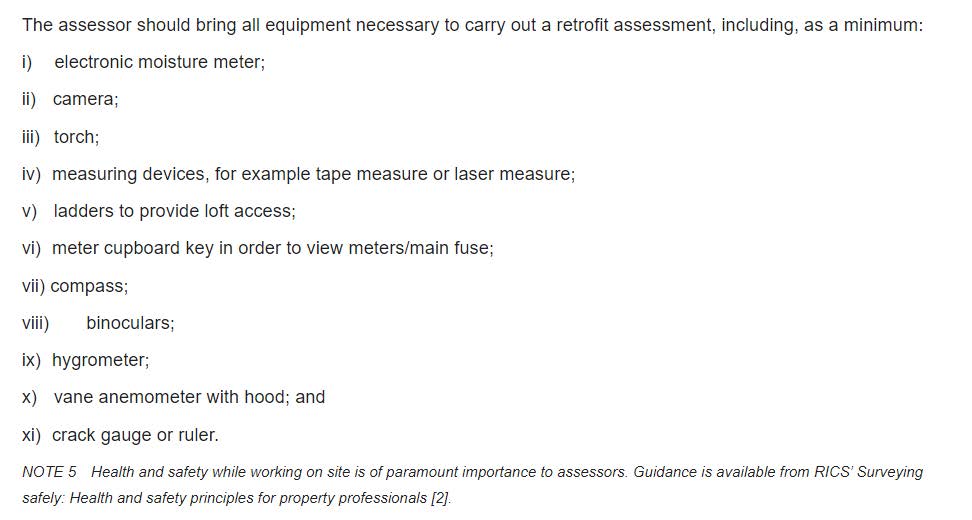
Retrofit assessors may not be familiar with all of this equipment or competent in how to use it effectively. There should be a section in the Annex explaining the equipment in detail and outlining where retrofit assessors can undergo additional training in its use (if required). This should outline the purpose of each piece of equipment (including what will it be used to measure or identify) and guidance on how to use it. It should also stipulate the standard of equipment required, as this could affect the accuracy of the results.

Context assessment (Section 5.1)
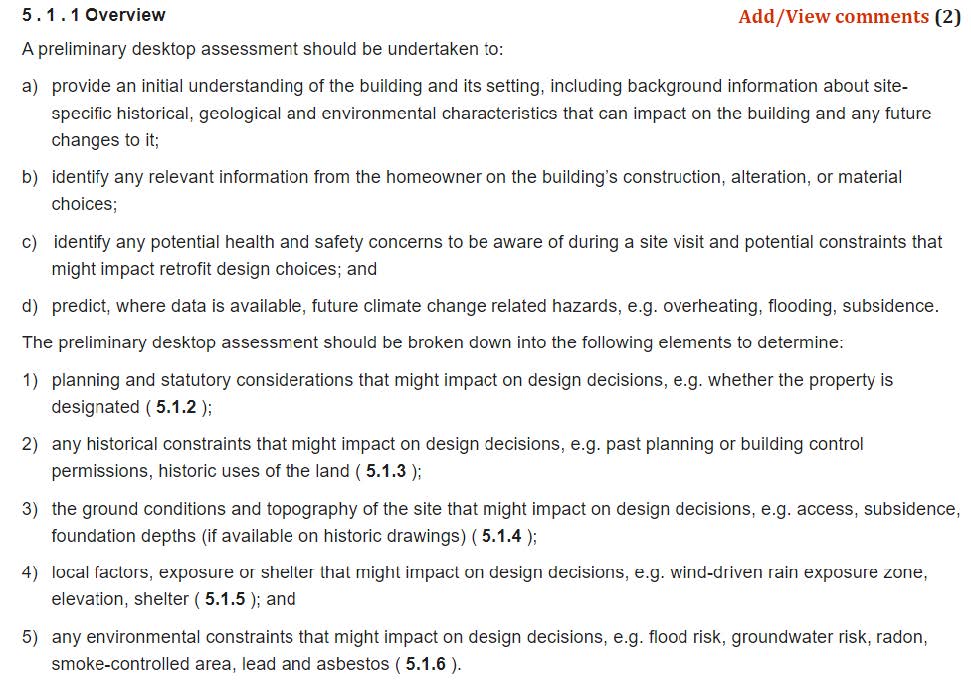
The context assessment is defined as a preliminary desktop assessment but is very broad and detailed in scope. For most government-funded schemes, a significant percentage of retrofit assessments are completed that, for a variety of reasons, never progress to an actual project. As such, the requirement for a highly detailed upfront desktop assessment will add delivery cost to existing retrofit schemes. Some aspects of it might not be necessary given that an in-depth site assessment will be carried out a later stage, hence an overly detailed desktop context assessment might duplicate effort and add unnecessary additional costs. Some of the activities within this context assessment and other sections of the code could potentially be completed after measures have been specified for a property to avoid wasting time and resources on assessments that do not progress to installation stage.

Condition assessment and condition rating (Section 6.1.1)
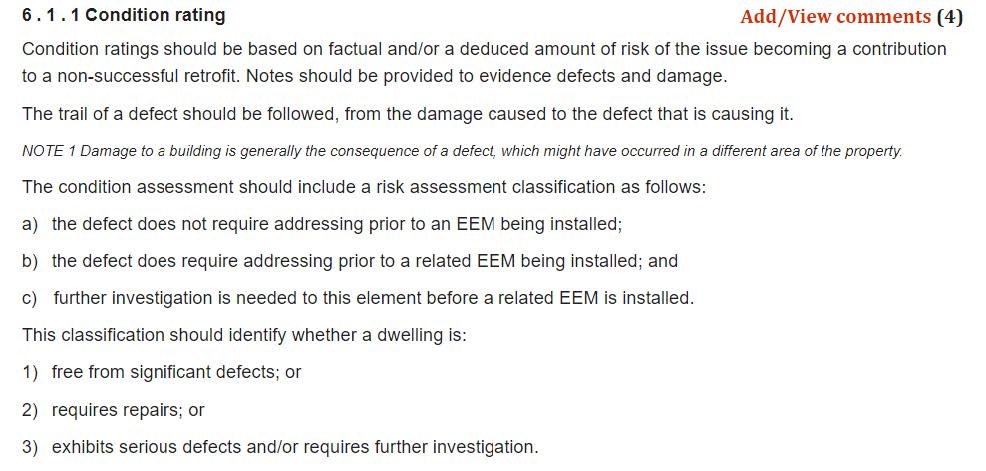
The content of this condition assessment seems closer to that of a Level 3 RICS Home Survey than the current retrofit assessment requirements. In practice, it is likely that many retrofit assessors will default to Option c) because they lack the specialist construction knowledge or data to make an informed decision on whether defects need addressing or not. Current retrofit assessors will not always have the expertise to follow ‘the trail of a defect’ and identify its root cause. In many cases, the root cause of a defect is often impossible to determine without an intrusive survey.

A thorough retrofit assessment might save time and money in the long term, as comprehensive data collection at this stage may reduce the number of additional site visits and further investigation that are required at later stages of the retrofit project. Within PAS 2035, there are a number of other surveys and inspections that need to take place. It is important that there is no duplication of effort between the code of practice and these other surveys. In order to realise the potential for efficiencies later on in the retrofit process, it is important that the results of the condition assessment and other surveys are shared with other relevant stakeholders working on the retrofit project.

A background ventilation assessment is a complex requirement which is beyond the competency of many retrofit assessors. This should be carried out by a qualified and competent specialist.

Occupancy assessment (Section 6.3.1)
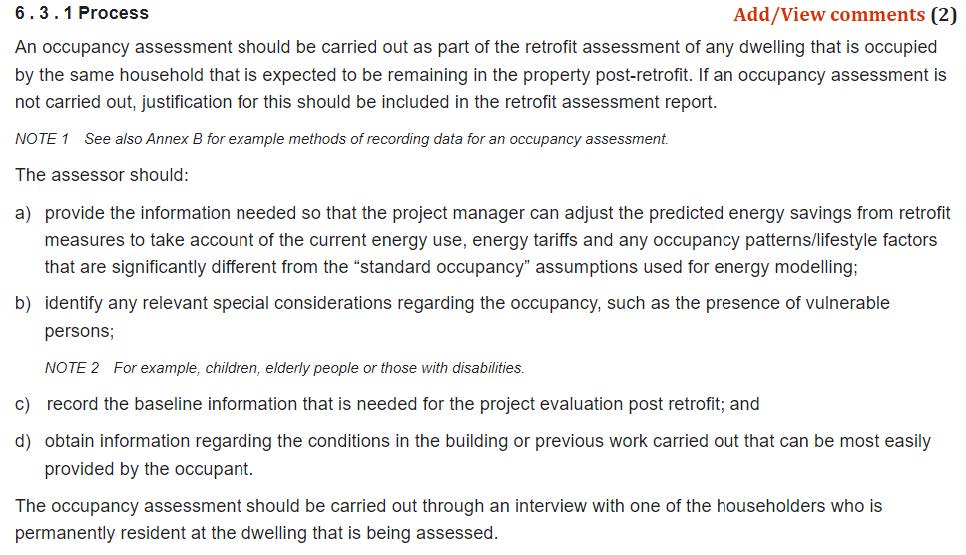
The stated purpose for an occupancy assessment is so that ‘the project manager can adjust predicted energy savings from retrofit measures’ to take account of factors such as occupancy patterns, energy use and tariffs. However, it will be very challenging to collect all of the data required for a full occupancy assessment. Many households will not have data on their energy use and tariffs over the previous 12 months easily to hand, while the innovative and fast-moving market for tariffs will further complicate efforts to accurately gather this data. Moreover, an interview with the residents may not be possible in all cases. Some tenants may not be able or willing to fully partake in an interview. Conducting an interview during every retrofit assessment could significantly increase the time and cost associated with carrying one out.

This code of practice stipulates that an occupancy assessment is required as part of every retrofit assessment. However, the imminent introduction of RdSAP10 means that there will be no formal methodology for conducting occupancy assessments, or software approval mechanism. This is likely to lead to a lack of consistency across assessments.

An occupancy assessment is useful for certain purposes, such as:

  • Helping the retrofit coordinator to calculate payback periods;
  • Assessing moisture management which will influence ventilation requirements;
  • Identifying operational defects.

However, the additional insights gained from such a detailed occupancy assessment may not be worth the additional time and effort invested in it. At the moment, very few retrofit designs consider the results of occupancy assessments, as there are not many energy efficiency measures that would be impacted by the outcome of an occupancy assessment.

Assessor competencies (Annex C)

The scope of the retrofit assessor role and what they are capable of needs to be considered carefully. Some of the activities here seem to overlap with the work of the pre-installation building inspection (PIBI) and could potentially be covered within that. Other aspects require a high level of general construction knowledge which not all retrofit assessors may have, particularly those who do not come from a construction background.

The existing retrofit assessor workforce does not currently possess all of the competencies outlined in Annex C, hence a substantial upskilling and retraining of the current retrofit assessor workforce will be needed to implement it effectively. Therefore, this code of practice should be accompanied by a concerted drive to improve the training and competency of the existing retrofit assessor workforce so that it is sufficiently prepared for its introduction. This should include increased funding and support for businesses to train and upskill employees.

Qualifications (Annex D)
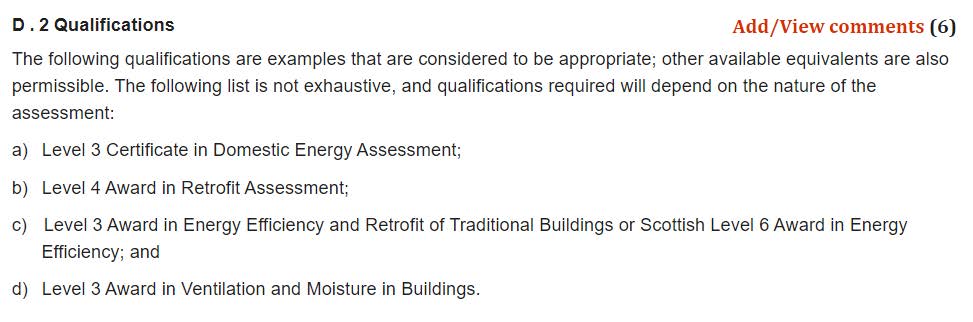
The level of detail within this code of practice is beyond the current content of many retrofit assessor training courses. Therefore, many existing training courses will need to be improved to align with this new code of practice.

Summary – SHDF Wave 3 Draft Guidance

Summary – SHDF Wave 3 Draft Guidance

The Social Housing Decarbonisation Fund (SHDF) provides energy efficiency measures to social housing across England. Wave 3 will run from April 2025 to September 2028, and will provide social housing providers with £1.2 billion of government funding to retrofit their housing stock. You can read the draft guidance in full here.

Headline proposals

  • There are two new routes to access funding under Wave 3, via the Challenge Fund and via Strategic Partnerships.
  • Wave 3 includes a cost cap of £7,500 of grant funding per home. This cap can be averaged across homes in an application (including across different consortium members).
  • There is also an additional £7,500 grant funding cost cap for low carbon heating measures in homes off the gas grid.
  • There is a new optional low carbon heating incentive for homes on the gas grid. Up to 10% of homes in an application can gain access to a £20,000 grant fund per home to install low carbon heating measures on the gas grid (instead of the usual £7,500 on the gas grid cost cap).

Main changes from previous waves

Delivery window

The Wave 3 delivery window will run until 30th September 2028. All grant funding for SHDF Wave 3 projects must be transferred to the Grant Recipient and spent by 31st March 2028, and within the financial year the grant funding was allocated, meaning projects can only use co-funding in the final 6 months of delivery.

Project grant funding spend must be aligned to the SHDF spend profile of 40% in FY25/26, 40% in FY26/27 and 20% in FY27/28.

Performance outcomes

Grant Recipients are expected to get homes to EPC C, however DESNZ accept that there may be circumstances where this is not achievable within the cost caps. If this is the case, homes are expected to attain the maximum EPC grade achievable within the cost caps. The 90/kWh/m2/year space heating demand consideration in Wave 2 no longer applies for Wave 3.

Homes which cannot reasonably reach EPC C within the cost cap are exempt from this requirement. However, at Phase Request stage, Challenge Fund Grant Recipients must demonstrate why it would cost over £15,000 to get the home to EPC C).

Cost caps

There is a new single cost cap for energy efficiency measures which is consistent across all homes and does not vary by starting EPC band or wall type as it did in Wave 2. The Wave 3 cost cap is £7,500 of SHDF grant funding from the Government per home. In addition to this government funding, social housing providers must provide a minimum of 50% co-funding. This means that the average capital spend per home will be £15,000 for the installation of fabric efficiency measures (assuming 50% co-funding).

This cap can be averaged across homes in an application (including across different consortium members). Therefore, it is possible for applicants to spend more or less than £7,500 of grant funding per property, as long as the average amount of grant funding spent across an application is less than or equal to the £7,500 cost cap.

In Wave 3, there are also additional cost caps for low carbon heating measures, which are outlined in more detail below.

Additional off gas low carbon heating cost cap

There is an additional £7,500 grant funding cost cap for low carbon heating measures in homes off the gas grid. This will be available in addition to the baseline £7,500 energy efficiency cost cap and can also be averaged out across homes. This means that applicants will be able to access a total of £15,000 of SHDF grant funding from the Government for off gas homes, split into 50% for energy efficiency measures and 50% for low carbon heating. When combined with 50% co-funding, this means that applicants will be able to spend £30,000 per property on off gas homes.

New Wave 3 on gas grid low carbon heating incentive offer

Wave 3 includes a new low carbon heating incentive for on gas grid homes. For up to 10% of the homes in an application, applicants will be able to access a grant of £20,000 per home. The entire £20,000 will come from the Government’s SHDF funding, so there is no co-funding requirement. For homes making use of the £20,000 incentive offer, installation of low carbon heating is mandatory. It is expected that the £20,000 is also used for energy efficiency measures to ensure that bills do not go up.

The only heating systems eligible for this offer are:

  • Air source heat pumps
  • Ground source heat pumps
  • Shared ground loops
  • Heat networks.

Summary

Table 1 below provides a summary of the different cost caps operating within SHDF Wave 3.

Eligible measures

Any energy efficiency and heating measures compatible with SAP are eligible under SHDF, excluding systems solely powered by fossil fuels. However, only a limited number of heating systems are eligible for new £20,000 on gas grid low carbon heating incentive offer. Heating systems eligible for this incentive are listed in Section 4.2.

  • Solid biomass. Whilst solid biomass is an eligible measure, this is only expected to be installed in exceptional circumstances where heat pumps are unsuitable for the dwelling, and only in rural areas where there are no air quality restrictions.
  • Hybrid heat pumps. Hybrids are an eligible measure for homes currently heated by mains gas, however they are not permitted in homes off the gas grid.
  • Smart technologies. SAP-eligible technologies which would enable Smart Meter Enabled Thermal Efficiency Ratings (SMETER) (such as smart thermostats) are an eligible measure.

Revisiting homes

Homes previously treated in SHDF Wave 1 or the SHDF Demonstrator are eligible to be treated in SHDF Wave 3 as long as they comply with SHDF Wave 3 eligibility requirements and only where installing low carbon heating measures. Homes treated in SHDF Wave 2 are not eligible.

Minimum number of homes

Wave 3 Challenge Fund applications must include a minimum of 100 eligible social housing properties at EPC band D-G per application. Small social housing landlords (those who own or manage fewer than 1000 homes) can apply with fewer than 100 homes. Strategic Partnership applicants will be expected to propose projects of significant scale, which retrofit thousands of homes.

Application timelines

Eligible properties

All social housing below EPC C is eligible for SHDF Wave 3 funding, apart from homes already retrofitted during Wave 2 of SHDF.

Homes at EPC C or above

In previous Waves of SHDF, homes already at or above EPC band C could only be included on an infill basis. In Wave 3, this is still the case, but there is also another instance whereby homes at EPC C or above can be included. This applies to homes where low carbon heating measures are being installed. In both instances, applications are limited to a maximum of 10% of all homes within the bid being at or above EPC band C.

Infill

Where a small number of properties in a block or terrace are at EPC Band C or above, they can be included in bids where work to those properties enables effective works to social housing below EPC Band C. Challenge Fund Applicants must justify this approach in Phase Requests, including providing the % of properties at EPC Band C or

above. There would need to be a significant reason for inclusion of these properties – any application without appropriate justification will not be successful.

This infill funding can only be used to install insulation, ventilation and low carbon communal heating.

Low carbon heating measures

Homes at or above EPC band C are eligible for the installation of low carbon heating measures. This applies to homes accessing the off-grid low carbon heating cost cap, or the on-grid low carbon heating incentive.

Mixed tenure and non-social homes

Private homes may be eligible for funding under the Wave 3 infill policy on non-social homes. Shared ownership homes also fall under the scope of Wave 3 infill policy.

Infill of non-social homes can only apply:

  • In a situation where social homes would be adversely affected without it, for example cases where social homes would not be able to meet EPC C without works taking place on non-social homes, or where works must be undertaken on a whole block for planning or logistical reasons.
  • To a maximum of 30% of the homes in the application bid.
  • To insulation, associated ventilation, and communal low carbon heating measures.

The requirement for owner occupiers and private rented sector landlords/tenants to contribute to measure costs that applied in previous waves of SHDF no longer applies.

Mixed tenure blocks and terraces are eligible for SHDF funding. In any block/terrace being treated, at least 30% of the homes within the block/terrace must be social homes.

Installers

All installers of energy efficiency measures under SHDF must be TrustMark Registered, certified to MCS (or equivalent) for the technology they are installing. All projects must be compliant with PAS 2035/2030:2019.

Administration and Ancillary Costs (A&A)

A&A costs are expected to be as low as possible, with a requirement that grant funding for A&A comprises no more than 15% of total grant spend by the end of the project.

Interaction with other energy efficiency schemes

Applicants may use funding from other government schemes, such as the Energy Company Obligation (ECO), to support works on the same home but funding from multiple government schemes cannot be used to fund the same individual measure twice.

Retrofit information, support and expertise

Technical assistance for SHDF Wave 3 will be delivered under the name of ‘RISE’ – Retrofit Information, Support and Expertise – through Turner & Townsend.

The Department for Energy Security & Net Zero (DESNZ) expects that Applicants will inform RISE about their intent to apply for SHDF Wave 3. Applicants can do so via the self-assessment form found at www.riseretrofit.org.uk or email rise@turntown.co.uk.

Application Routes

Challenge Fund

The vast majority of applicants are expected to access funding via this route. All Challenge Fund applications that meet the minimum standards of the scheme will be awarded funding (although if oversubscribed, this may not be the amount of funding requested).

Applications are assessed against the following criteria:

  • Strategic fit: an assessment of how well the proposal fits with the aims, desired outcomes and eligibility criteria of the SHDF Wave 3 Challenge Fund.
  • Delivery forecast: an assessment of the plan for the project, including proposed costs.
  • Commercial assurance: an assessment of the feasibility and credibility of the approach to procurement as well as of the proposed contracts required to move to Phase Request stage.
  • Delivery assurance: an assessment of the feasibility and credibility of the project including resource; project management strategies; risk and issues management and confidence in delivery of the project.

The phase approach

The Challenge Fund model will be delivered according to a phased approach, whereby groups (or batches) of homes are submitted to DESNZ in phases. Each phase will cover all or a proportion of the homes within a project. DESNZ expects that no project will have more than 10 phases or less than 10% of total homes in any one phase.

Before measures are installed in any homes, a Phase Request covering those homes must be submitted to and approved by DESNZ. The information in each Phase Request should be based on a significant number of completed retrofit assessments to ensure confidence in the accuracy of the information provided. DESNZ suggests that this should cover c.70% of flats in a block, or c.90% of homes where they are spread out.

Applicants will not be required to provide detailed information on specific homes and measures at the initial application stage. Instead, they will simply need to demonstrate that they will be able to deliver a project to the required specifications. More detailed information on homes is required only when applicants submit Phase Requests. Applicants must quantify the mix of measures they are intending to install at Phase Request stage and why they are the most suitable measures.

Figure 1 below sets out the application and delivery process for the Challenge Fund.

Assessment of Phase Requests

Phase requests will be assessed by DESNZ according to the following criteria:

  • Strategic fit: an assessment of how well the proposal fits with the aims, desired outcomes and eligibility criteria of the SHDF Wave 3 Challenge Fund.
  • Contractor procurement: An assessment of the suitability of the contractors that have been procured for delivery of this phase.
  • Delivery assurance and internal resourcing: an assessment of the feasibility and credibility of the project, including organisational design, fraud management and planning.
  • Delivery forecast: an assessment of the proposed activities and spend to take place each month.
  • Value for money: an assessment of the costs of the proposed measures to be installed, a cost breakdown of the phase and a justification for the cost of the phase.

If a phase request is approved, applicants will be allowed to start delivery on that phase of homes. If it is rejected, applicants will be directed to further and asked to re-submit after making changes.

Payment of the grant

In the Challenge Fund route, Lead Grant Recipients will only be able to draw down up to 20% of their total grant funding award before their Phase Requests are approved; made up of 15% A&A and 5% capital. They will be able to draw down the remainder of the grant following the approval of Phase Requests.

Strategic Partnerships

A small number of Grant Recipients with a proven track record of successful delivery at scale (1000s of properties) can access funding through a Strategic Partnership. To reflect the capability evidenced by these landlords and to support delivery at scale, these Grant Recipients will not be required to provide detail on specific homes and measures until works have been carried out, as part of routine delivery monitoring.

To be eligible for a Strategic Partnership, the Lead Applicant must have delivered on the SHDF Demonstrator, Wave 1, and Wave 2.1 or Wave 2.2, either as the Lead Grant Recipient or as part of a consortium.

Strategic Partnership Applicants will be expected to propose projects of significant scale, retrofitting multiple thousands of homes.

Application process

The application process for Strategic Partnership applications will place a reduced focus on specific project detail and a greater emphasis on evidence of delivery capability.

Strategic Partnerships, applications will be assessed on how well they meet SHDF’s four, equally weighted, strategic priorities. There are up to 10 points available for each strategic priority, so applications which deliver on a greater number of priorities are potentially able to score more highly, but applications that do not deliver on every strategic priority will not be automatically ruled out.

The four strategic priorities are listed below:

Strategic Partnership Lead Applicants will be informed of the outcome of their application before the closure of the Challenge Fund application window. Therefore, any unsuccessful Strategic Partnership Applicants will still have the opportunity to submit an application to the Challenge Fund if their Strategic Partnership application is rejected.

At initial application, Challenge Fund Applicants will not be required to provide information on specific homes to be upgraded or specific measures to be installed. Instead, Applicants will be asked for information to demonstrate that they will be able to deliver a project to the required specifications.

The Home Energy Model: Future Homes Standard Assessment

The Home Energy Model: Future Homes Standard Assessment

The Home Energy Model (publishing.service.gov.uk)

Closing Date: 27 March 2024
Response submitted by: National Insulation Association
For more information, please contact: info@nia-uk.org

About the National Insulation Association
The National Insulation Association (NIA) represents the insulation industry in the UK with a member base comprised of installers, system certificate holders, and manufacturers who provide a wide range of insulation solutions for homes and buildings. The NIA and its members are fully committed to maintaining and raising standards within the insulation industry.

What are your views on the choice of name for the new model? Please provide your reasoning and any supporting evidence.

We are satisfied with the choice of name.

What are your views on the choice of name for the version of the model which is to be used to demonstrate compliance with the Future Homes Standard? Please provide your reasoning and any supporting evidence.

We are satisfied with the choice of name for the FHS assessment version of the HEM. It makes sense to include specific reference to the FHS, as this makes it clear what the model’s application will be and distinguishes it from the underlying model.

What are your views on using the open-source code as the approved methodology for regulatory uses of the Home Energy Model? Please provide your reasoning and any supporting evidence.

The NIA welcomes the move to publish the open-source code, as this will aid transparency and promote greater understanding of the methodology among relevant stakeholders. It will also give industry experts the chance to scrutinise the code and suggest improvements or raise any potential concerns. This should improve the overall effectiveness of the model.

If the open-source code is used as the approved methodology for regulatory uses of the HEM, we would like to see more clarity and guidance on what the process will be for dealing with errors in the code, in particular around liability and the transfer of risk. If there are errors with the centralised code, it is important that risk and liability is not transferred onto individual software providers who use the code as a basis for producing EPCs and determining compliance with building regulations. It is also important to avoid a situation whereby errors in the code become embedded into law.

It is important that making the open-source code the legal basis for the methodology does not act as a barrier to making necessary changes to the model in a swift manner. It must be possible for the HEM to be constantly improved and refined to improve its effectiveness. There is the potential that a codebase underpinned by regulation will be very slow to change. It is important that this does not act as a barrier to regular updates and improvements to the model. As mentioned earlier, if there are errors in the code, it is vital that these are rectified as soon as possible, without the need for a long, drawn-out regulatory process.

Whilst we agree with publishing the open-source code, it is important that other documents are published alongside it so that people not familiar with Python are still able to understand the methodology behind the model. It is encouraging to see that the Government will be publishing accompanying technical documents to provide further explanation about the model. This will ensure that the methodology is accessible to a wider range of people, thus aligning with the Government’s objective to make the HEM more transparent.

What forms of collaboration would you be interested in for future development of the Home Energy Model codebase? Please provide further details.

There must be a clear process for managing, evaluating and updating the codebase. It is important that industry is involved in this process so that they can shape the future development of the codebase.

What are your views on our assessment of issues with the current SAP delivery model? Please provide your reasoning and any supporting evidence.

We agree with the issues outlined with the current delivery model, however it is unclear how the HEM will resolve all of these, in particular the inertia of the SAP methodology. If the codebase is embedded in regulation, this could complicate and slow down the process of making changes to the methodology. Introducing a centralised, cloud-based version of the code has the potential to enable quicker updates to the methodology. However, it is not entirely clear how this would operate in practice and what the relationship would be with accompanying regulations.

Lack of accountability is a key issue, however it is still unclear from the consultation proposals where the balance of accountability will lie with the HEM. We would welcome clarity on who will be accountable, whether this be the Government, BRE, or independent software providers. If the Government proceeds with a centralised, cloud-based version of the HEM, this could simplify the issue of accountability.

At the moment, different software providers all have differing versions of SAP which can cause inconsistencies in results, although these tend to be small. Having a centralised, standardised code should help to minimise these inconsistencies in results. It should also help to clarify the accountability of different parties by providing one consistent version of the ‘truth’.

What are your views on the concept of a centralised, cloud-based version of theHome Energy Model, to be used for regulatory purposes? Please provide your reasoning and any supporting evidence.

We agree with the concept of a centralised, cloud-based version of the HEM. Currently, different software providers have differing versions of SAP which can lead to inconsistencies in results. Centralising and standardising the model will help to increase accuracy and minimise these inconsistencies. The ability to make quick updates to the central platform is key.

It can be unclear where the balance of accountability lies with the current version of SAP, whereby different software providers implement differing versions of the methodology independently. Having a centralised, standardised model will help to clarify where accountability lies and transfer risk away from software providers. It is important that it is clear which body is ultimately responsible for the HEM (whether this be BRE or the Government).

The provider of the centralised model (BRE for example) will need to understand and put in place appropriate support arrangements to allow independent software providers to easily build user interfaces around the central platform.


What are your views on revising the database of product characteristics (currently the “PCDB”) for the Home Energy Model? Please provide your reasoning and any supporting evidence.

We agree with the intention to revise the database of product characteristics for the Home Energy Model. It is important that the PCDB is based on accurate and up-to-date data, and includes the most effective technologies currently on the market.

What changes would you recommend to the PCDB data collection procedures? Please provide your reasoning and any supporting evidence.

It is costly for manufacturers to get their products listed in the PCDB. This prohibitive cost means that many products are not listed on the database because it isn’t worth the effort and cost for manufacturers to apply for their products to be listed. The process should be streamlined and made more cost-effective for manufacturers, as the cost of getting products listed is a significant barrier for many.

What are your views on our assessment of issues with the way SAP currently recognises new technologies (currently the “Appendix Q process”)? Please provide your reasoning and any supporting evidence.

We agree with the issues identified around the Appendix Q process. In general, the process is too costly and time-consuming which can act as a barrier for new innovative products being recognised via SAP. The HEM must make it easier for innovative new products to become recognised.

What are your views on the principles for how the Home Energy Model will recognise new technologies once it is in use? Please provide your reasoning and any supporting evidence.

We support the principles set out in the consultation for the how the HEM will recognise new technologies. However, more detail is needed on how the process will work in practice. The reformed Appendix Q process should focus on reducing the cost burden and length of time that it takes for innovative technologies to gain recognition, as this can prove a significant barrier to new innovations entering the market and becoming commercially viable. Ultimately, the HEM needs to enable innovation rather than hinder it.

The opportunity for continuous evaluation should enable regular “live” updates to the HEM which may make it easier and quicker for new, innovative technologies that come onto the market to be recognised by the HEM. Greater integration with other innovation routes such as ECO4 is welcome to avoid the need for companies to duplicate unnecessarily a process which can be costly and time-consuming. More detail is required on how this integration will work in practice.

The ability of innovative technologies to become recognised within SAP also depends on the underlying measurement standard. If the underlying standard is not broad enough to cover innovative technologies, then it is difficult for them to be introduced.

What are your suggestions for other wrappers that could be developed for the Home Energy Model in future? Please provide your reasoning and any supporting evidence.

The proposals identify the main wrappers that should be included within the HEM, excluding the very important EPC wrapper which will be consulted on later this year. In general, we welcome the use of wrappers, as they should improve on the SAP process, however, the HEM’s modelling will only be as accurate as the data inputted into it, therefore it is important to choose the most suitable wrappers to achieve more accurate and reliable outputs.

The effectiveness of wrappers depends on how straightforward it is to interact with the core engine and what controls will be on it. At the moment, it is unclear how open the interface will be and how easy it will be to implement new wrappers. If it Is easy to add new wrappers and build software interfaces, then the wrapper system has the potential to be a lot more efficient than the current system, which can make producing an EPC quite a time-consuming and laborious process. If the wrapper process is efficient and accessible, it should be possible to quickly produce an output wrapper, whereas in SAP it can take hours to manually write up a report.

What are your views on the increased time resolution offered by the Home Energy Model? Please provide your reasoning and any supporting evidence.

The NIA welcomes the increased time resolution offered by the HEM. This will increase the accuracy of the HEM compared to SAP and bring a range of other benefits including:

  • More accurate modelling of heat pump performance and importantly the interaction with other building elements within the whole building system.
  • Better alignment of the HEM with improvements in real-time monitoring and evaluation of building performance. Enabling these improvements to be reflected within the model will enhance its accuracy and help to close the performance gap.
  • More recognition of the benefits of smart technologies and the importance of energy flexibility.

Despite the clear benefits of increasing the time resolution, we are concerned by the longer runtime of the HEM which has been identified as an issue by the Government. Industry urgently needs more detail and clarity on exactly how long the expected runtime of the HEM will be. It is very important that the HEM still has a reasonable runtime that does not make the model impractical to run. For instance, a runtime of 5 minutes, although not ideal, would most likely still be workable for industry. By contrast, a runtime of 15 minutes or more would represent a substantial challenge for SAP users and would significantly reduce the effectiveness of the HEM in practice.

What are your views on the choice of BS EN ISO 52016-1:2017 (in its half-hourly
form) as the basis for the Home Energy Model? Please provide your reasoning and any supporting evidence.

The move to BS EN ISO 52016-1:2017 which is a recognised industry standard seems reasonable. There are clear benefits associated with moving to a standard that supports the HEM’s half-hourly simulation.

What are your views on the ability of the Home Energy Model to model energy flexibility and smart technologies? Please provide your reasoning and any supporting evidence.

The half-hourly time resolutions of the HEM gives it the potential to model energy flexibility much more accurately than SAP.

The usefulness of the HEM for modelling energy flexibility depends on the range of applications it is used for. The existing SAP methodology focuses on the building as an asset and ignores the occupants and their energy consumption habits in favour of standardised assumptions. The HEM’s potential for modelling energy flexibility is unlikely to be relevant when assessing a building’s compliance with building regulations for example, as this is solely based on the building’s performance as an asset. Energy flexibility is dependent on energy suppliers and occupants which is largely out of the control of developers and retrofit contractors.

It is clearly useful to have a model that can take into account energy flexibility and the use of smart technologies, particularly as these start to become more commonplace in homes. It is important to have a model that is responsive to changing patterns of energy consumption and the increased energy flexibility that smart technologies can bring for residents. However more detail is required from government on how it intends to use the HEM’s potential capabilities around energy flexibility and smart technologies. For instance, this could be used to model custom energy demand.

What are your views on the methodological approach for calculating space heating and cooling demand? Please provide your reasoning and any supporting evidence.

We support the methodological approach for calculating space heating and cooling demand. The new approach, as well as the use of more detailed inputs, will model the space heating demand of buildings more accurately than SAP. It is possible that it will lead to a higher space heating demand calculation than SAP, which will incentivise greater reductions in energy demand through increased fabric efficiency.

What are your views on the methodological approach for calculating fabric heat loss? Please provide your reasoning and any supporting evidence.

We agree with this approach.

What are your views on the methodological approach for calculating thermal bridges? Please provide your reasoning and any supporting evidence.

We agree with this approach.

What are your comments on the methodological approach for calculating infiltration and/or controlled ventilation? Please provide your reasoning and any supporting evidence.

We agree with the methodological approach for calculating infiltration. This should increase accuracy because it takes into account more factors and uses wind speeds updated on an hourly basis, making it much more receptive to changes in weather conditions. The omission of other contributing factors such as wind direction and “stack effect” from the HEM are unlikely to have a significant effect on the accuracy of the modelling. However, we would support their future inclusion, along with any other updates which increase the granularity and accuracy of the modelling. We also support replacing the fixed minimum dwelling ventilation rate with a wrapper input value as this will make the modelling more dwelling-specific.

What are your views on the methodological approach for calculating thermal mass? Please provide your reasoning and any supporting evidence.

We welcome the approach to include the entire building envelope within thermal mass calculations. This should produce a more accurate calculation than SAP 10.2 which only takes part of the construction envelope into account. Including warm up and cool down rates will also increase accuracy compared to the current approach based on a one-off, instantaneous value which doesn’t reflect how buildings warm up and cool down in practice.

While we support the desire to be as accurate and dwelling-specific as possible, we do not agree with the proposal to include the thermal mass of furniture in thermal mass calculations. Many properties, especially in the non-domestic sector, are unfurnished. It is not clear how the current approach would account for unfurnished properties. Furthermore, it doesn’t make sense for furniture to be taken into account when determining a building’s SAP rating or compliance with building regulations. This is often out of the control of developers and may depend on the personal choices of residents. We do not think that the negligible increase in accuracy that including furniture in thermal mass calculations will bring outweighs the issues that this approach may create.

What are your views on the methodological approach for calculating solar gains and solar absorption? Please provide your reasoning and any supporting evidence.

We support the approach for calculating solar gains and solar absorption, as it should provide more accurate results than the current version of SAP.

What are your views on the methodological approach for calculating heat losses from Domestic Hot Water pipework? Please provide your reasoning and any supporting evidence.

We are pleased to see that the model will take into account pipework, rather than using a standardised assumption. This will improve the accuracy of the model, as factors such as insulation levels can have a significant impact on heat losses from pipework.

However, the methodology does not seem to take into account the location of the pipework which could influence the calculation. It is important to distinguish between sections of pipework that are in the thermal envelope and those that are outside of it (in the roofwork, for instance) because heat loss from pipework in the thermal envelope could contribute to space heating, thereby skewing calculations.

What are your views on the methodological approach for calculating heat losses from hot water cylinders? Please provide your reasoning and any supporting evidence.

We agree with this approach.

What are your views on future features development for the Home Energy Model? Please make suggestions, explaining your reasoning.

We welcome the Government’s commitment to develop future features in the open. Given that there are key elements of the model which are yet to be finalised and may require further development, it is important that industry is properly consulted throughout its ongoing development, so that businesses can give their views and inform the development of aspects like future features.

The freedom to interact with the open-source code without too many restrictions will be important for software designers. This will allow them to build user interfaces and develop different end uses for the model without a prohibitive cost of entry.

What are your views on the inter-model validation work that has been carried out (i.e. comparison against SAP 10.2 and validation against PHPP and ESP-r)? Please provide your reasoning and any supporting evidence.

We agree with work carried out to benchmark against other models. This approach is sensible and takes account of the most relevant models. It is likely that the introduction of the HEM will shift the goalposts compared to SAP, most likely resulting in lower SAP scores and requiring higher standards of energy efficiency for compliance with building regulations. This is generally positive as it supports the transition towards more energy efficient, ‘Net Zero Carbon ready’ buildings. However, it is important that this aspect of the HEM’s implementation is carefully managed in a way that does not have a detrimental effect on residents, retrofit businesses, and others in the sector.

The findings of the inter-model validation seem to be generally positive. It is critical that these learnings, particularly the areas for improvement identified, are fully addressed in the next stage of the HEM’s development.

What are your views on the validation work that has been carried out against real-world case studies (i.e. IEA Annex 58, Camden Passivhaus, and Marmalade Lane)? Please provide your reasoning and any supporting evidence.

The validation work against real-world case studies is encouraging. It suggests a fairly high level of accuracy within the HEM when compared to real-world performance data. The Marmalade Lane case study findings show that the HEM was consistently more closely aligned with measured data than SAP 10.2, which is positive. This shows that the HEM is significantly more accurate than SAP in practice, and its introduction should help to close the performance gap between predicted and monitored energy use, which is one of the model’s primary aims.

What examples of real-world case studies, or other data, do you suggest be used to further validate the Home Energy Model? Please provide further information.

Contractors and software developers will run their own modelling using the open-source code. It is important that government carefully considers any feedback or issues that arise from independent modelling conducted by industry. It will also be important to gather more data on how residents’ behaviour affects the HEM’s modelling, as this is not explored in detail by the real-world case studies.


Call for Evidence: Decarbonising home heating – National Insulation Association response

Call for Evidence: Decarbonising home heating – National Insulation Association response

Decarbonising home heating – Committees – UK Parliament

Closing Date: 10 April 2024
Response submitted by: National Insulation Association
For more information, please contact: info@nia-uk.org
About the National Insulation Association The National Insulation Association (NIA) represents the insulation industry in the UK with a member base comprised of installers, system certificate holders, and manufacturers who provide a wide range of insulation solutions for homes and buildings. The NIA and its members are fully committed to maintaining and raising standards within the insulation industry.

Our response to the Call for Evidence

The NIA believe that a fabric first approach to home decarbonisation will provide the best outcomes for residents and best long-term value for money for government. A fabric first approach is the only way to ensure a just transition to net zero homes which does not result in higher energy bills for residents.

Heat pumps are expected to be the main low carbon heating technology for households going forward. In practice, the efficiency of heat pumps is receptive to the fabric efficiency of the home. A fabric first approach which ensures that the home is well-insulated prior to the installation of a heat pump will increase the system’s efficiency and reduce its running costs. Higher levels of insulation should also allow a smaller, cheaper heat pump to be installed that will have lower operating costs. Hence, a fabric first approach to decarbonisation is crucial to protect residents from overly high running costs and ensure that the switch to heat pumps is as affordable as possible for residents.

Since electricity is currently four times more expensive than gas per kWh1, there is a significant risk that, without energy demand reduction measures like insulation, households will be subject to higher energy bills when moving from a gas boiler to an electrified low carbon heating system. With an estimated 6 million households in fuel poverty, according to National Energy Action2, and 41% of all energy bill payers struggling to afford payments3, it is absolutely critical that the transition to decarbonised home heating does not result in higher energy prices for residents. Electricity prices are expected to remain well above pre-crisis levels for the rest of the decade4, therefore a sustainable long-term solution which reduces energy demand is needed in order to make the switch to electrified heating affordable for residents.

In the context of the ongoing energy crisis, the primary concern of the Government must be to make sure that residents are protected from higher energy prices. A fabric first approach to home decarbonisation is the best way to guarantee this in the long-term, as insulation measures reduce energy demand and bills for residents. This approach led to 145,000 households being lifted out of fuel poverty by energy efficiency measures between 2021 and 20225. Increased investment in energy efficiency measures will lift even more households out of fuel poverty in future and ensure that the transition to net zero homes is as affordable as possible for residents. This will make sure that the most vulnerable residents are protected throughout the transition to net zero. As the National Audit Office report points out, the Government has a legal commitment to both reduce emissions and meet its statutory fuel poverty targets6. By taking a fabric first approach to home decarbonisation, the Government can meet both of these legal obligations.

Short term investment in insulation measures not only delivers much-needed financial benefits to residents, it can also save the Government money in the long-term. It is expected that the decarbonisation of homes will be dominated by electrified low carbon technologies, meaning a vast expansion of the electricity network will be required to facilitate the roll out of electrified heating to the majority of homes. There is an enormous capital cost associated with developing more renewable generation capacity and expanding the electricity network to meet this increased demand. According to Ofgem and the Government, £170 billion – £210 billion will need to be invested in the grid by 2050 to achieve our net zero targets7. Therefore, demand reduction measures like insulation are vitally important to ensure that our homes use as little energy as possible to run. Investment in insulation in the short term could save the Government and taxpayers billions in the long run by reducing the extent to which we will need to expand the electricity network and build additional renewable energy capacity.

Insulation upgrades in the short term will also future-proof government and households against future energy crises. With a properly insulated housing stock, the Government will not need to spend billions on subsidising household energy bills in the event of future energy price shocks. For instance, in 2013, the Government decided to cut support for home insulation, which saw installation rates fall by around 90%8. Had the Government maintained 2013 levels of support for home insulation, this could have saved taxpayers £18 billion over the course of the Energy Price Guarantee, according to analysis conducted by the Energy & Climate Intelligence Unit9. Energy prices are set to remain high for the foreseeable future10, therefore, without increased investment in insulation, it is possible that the government may have to step in again with a very expensive support package should prices rise to unaffordable levels again. A fabric first approach to home decarbonisation would avoid this costly outcome and deliver value for money for government in the long term. Insulation measures offer a more cost-effective and permanent solution to high energy bills than nationwide energy bill support schemes. In this way, increased support for insulation now has the potential to save government and residents a significant amount of money in the future.

In addition to the significant financial savings it provides, insulation also has substantial health benefits for residents and wider society. Living in cold, damp homes can increase the risk of a number of illnesses, such as strokes, heart attacks, and respiratory diseases11. For instance, poorly insulated and ventilated homes can double the risk of children developing asthma12. Unfortunately, many homes are in this poor state, with 1 in 5 children in the UK currently exposed to damp and mould at home13. This highlights the urgent need to improve insulation and ventilation across our housing stock, thus helping to eliminate the scourge of damp and mould from homes along with the associated health issues they bring for residents which, as we have seen with the tragic case of Awaab Ishak, can be fatal(14)

The direct personal health benefits delivered by a fabric first approach to decarbonisation are also translated into wider public health and economic benefits to society. According to the Local Government Association, the NHS spends an estimated £2.5 billion per year on treating illnesses linked to cold, damp and unsafe homes15. This represents a significant burden on a health service which is already under significant funding pressures. A fabric first approach to home decarbonisation will create warmer, healthier homes and alleviate pressure on the NHS. Findings from the Energy Systems Catapult’s Warm Homes Prescription project found that enabling residents to live in warm, well-insulated homes reduced pressure on NHS services, with fewer hospital and GP appointments booked by those who had taken part in the trial16. The preventive health benefits it delivers makes insulation an excellent value for money investment for Government and taxpayers – investing £1 in retrofit is estimated to save £0.42 in direct health costs(17). Most importantly, a fabric first approach to decarbonisation will improve the personal health and wellbeing of residents, and enable people up and down the country to live in warmer, healthier and decarbonised homes.

Robust quality assurance is also crucial to ensure to ensure that public money is spent on high-quality installs which deliver the financial and health benefits outlined earlier without any unintended consequences. The Government must continue to ensure that public money is only spent on home decarbonisation projects that are delivered in accordance with the thorough quality assurance frameworks set out in PAS2030/35 and MCS. This is vital to protect consumers from harm. Without stringent quality assurance and consumer protections in place, there is a risk that the Government will open itself up to an increased number of legal complaints and compensation claims regarding sub-standard installs and property damage. As we rapidly increase the quantity of retrofit measures delivered over the coming years, it is imperative that we do not lose sight of the importance of quality. The race to net zero cannot become a race to the bottom in terms of quality standards. Any dilution in quality standards risks fatally undermining the net zero transition and irrevocably damaging consumer confidence in the home decarbonisation industry. Effective quality assurance is important to ensure that home decarbonisation measures deliver quality and value for money for government and residents.

Delivering home decarbonisation at scale without compromising on quality will require a significant increase in the size and skill level of the retrofit workforce. This represents a significant challenge, but also a huge opportunity. With sufficient targeted investment in retrofit skills and training, the Government has the opportunity to create thousands of high-quality, sustainable jobs in local communities across the UK. Based on the Climate Change Committee’s (CCC) projections, 120,000 to 230,000 jobs could be created across the UK construction sector in order to retrofit and insulate the UK housing stock – an 11% increase relative to the current size of the sector18. Importantly, these are also high-quality, skilled trades that pay well. According to Indeed, the average salary for an insulation worker in the UK is £37,17819 – above the national average. Most jobs in the insulation sector do not require a Level 6 qualification (undergraduate degree or equivalent), so employment in this sector will help to level up communities by providing high-skilled and well-paid technical employment for school leavers without a degree.

In addition, most energy efficiency work tends to be localised; therefore, installations will likely be carried out by local installers and businesses, thus ensuring that employment and growth opportunities remain within the local area where they are needed. Which’s recent Priority Places for Insulation Index report shows that many of the places most in need of future insulation upgrades are in deprived areas, for example former coalfields or coastal communities in the north of England20. As such, investment in insulation has the potential to support the Government’s levelling up mission by directing investment and jobs to areas that need it most. In this way, spending on insulation and wider retrofit skills represents a cost-effective investment for government because it creates well-paid, high-quality and sustainable jobs in local areas.

Despite the clear long-term benefits of insulation measures, we recognise that the upfront investment required can be costly for government. To mitigate this, we would like to see the Government provide more support for the development of innovative green finance mechanisms, which will make sure that home decarbonisation policies are cost-effective for government and taxpayers. The CCC estimates that retrofitting all of the UK’s housing stock will cost £250 billion by 205021. It is not reasonable or realistic to expect that government will provide fully funded grants to cover this cost. Neither can most households, many of whom have very limited savings22, be expected to fund the full upfront cost of retrofit without some form of support. Therefore, innovative green financing solutions which effectively mobilise private investment into the retrofit market and spread out the upfront cost of retrofit will be needed to ensure a net zero transition that is cost-effective for government. The Green Home Finance Accelerator represents a welcome start in this area, but the Government urgently needs to work with financial institutions and private investors to develop a range of effective green finance solutions that can be rolled out across the country. This is critical to create long-term, organic consumer demand for decarbonisation measures which is not reliant on expensive government subsidies.

In conclusion, a fabric first approach to decarbonising our homes represents the most effective way to fairly distribute the costs of the net zero transition. Short term investment in insulation will provide a number of longer term savings: reducing the cost of expanding the electricity network, avoiding the need for expensive energy bill support packages during future energy crises and providing significant public health savings, thereby reducing pressure on the NHS. Most importantly, a fabric first approach will enable residents to benefit from clean and affordable heating, along with improved health and comfort. Insulation is vital to ensure a just transition to net zero homes which protects the most vulnerable households in society.


1 Ofgem (2024). Energy price cap. Available here.
2 National Energy Action (2024). What is fuel poverty? Available here.
3 Office for National Statistics (2024). Cost of living insights: Energy. Available here.
4 Jillian Ambrose (2023). ‘Higher energy bills forecast for UK households next year’, The Guardian. Available here.
5 Department for Energy Security and Net Zero (2022). Fuel poverty factsheet: England, 2022. Available here.
6 National Audit Office (2024). Decarbonising home heating. Available here.
7 Regen (2023). Building a GB electricity network for net zero. Available here.
8 Rt Hon Chris Skidmore MP (2022). Mission Zero: Independent Review of Net Zero. Available here.
9 Energy & Climate Intelligence Unit (2022). Taxpayers facing £18 billion bill for failure to insulate UK homes. Available here.
10 Jillian Ambrose (2023). ‘Higher energy bills forecast for UK households next year’, The Guardian. Available here.